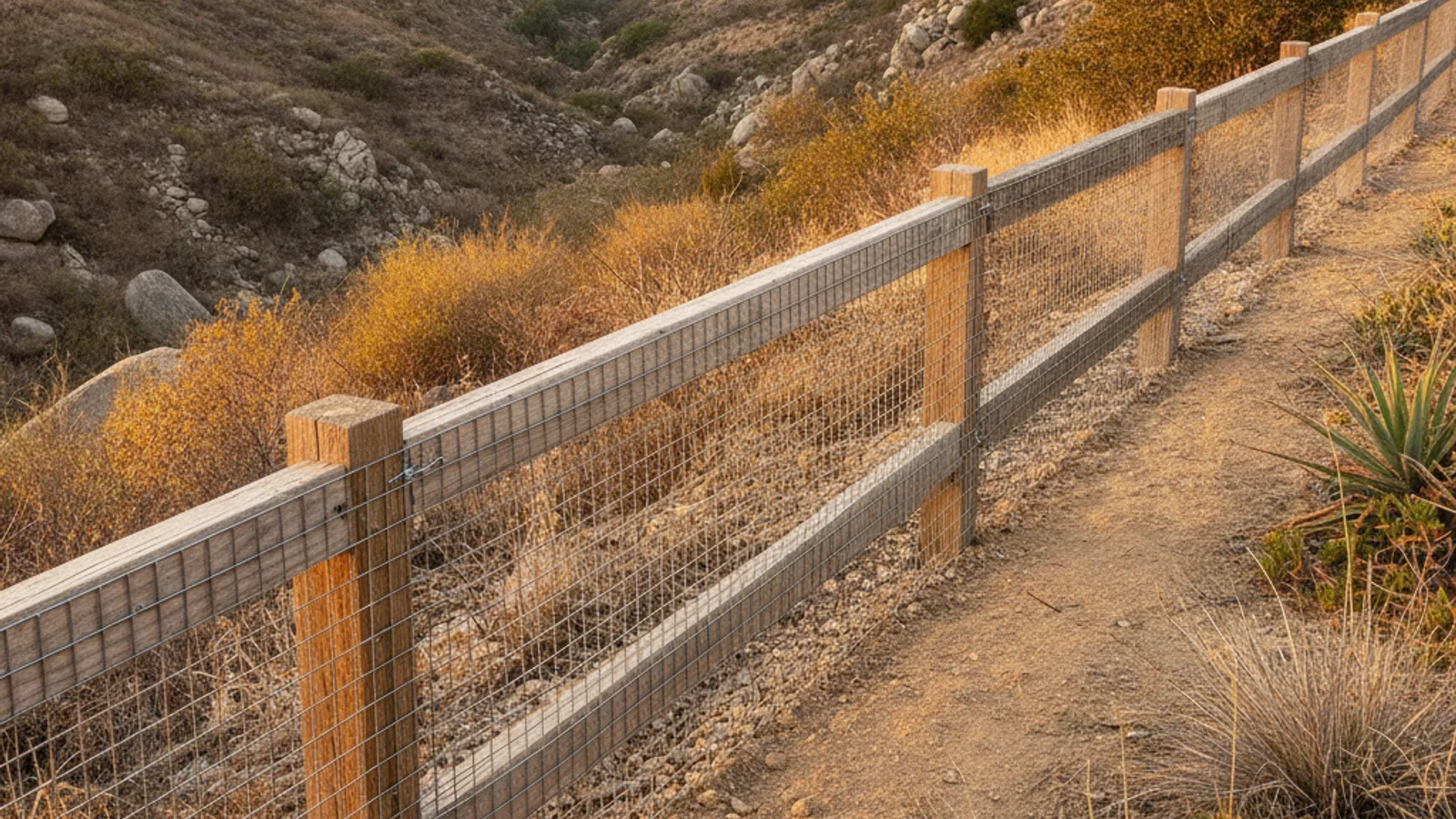
A rattlesnake-proof fence in San Diego needs quarter-inch steel mesh, at least 30 to 36 inches tall, buried a few inches into the ground, with the mesh fastened to the outside face of the fence. The mesh openings have to stay under a quarter inch because a newborn rattlesnake fits through anything larger. Rattlesnakes can’t climb a smooth solid surface, but they climb loose mesh easily, so the barrier goes on the outside where there’s nothing to grip, and every gate and seam gets sealed to the same quarter-inch standard.
San Diego County is home to three venomous rattlesnake species, according to the San Diego Humane Society: the red diamond rattlesnake, the Southern Pacific rattlesnake, and the Southwestern speckled rattlesnake. They’re most active in the warm months, roughly spring through fall, and they show up wherever chaparral, canyon, and decomposed-granite terrain meets a backyard. That’s a lot of San Diego. Foothill and backcountry neighborhoods see the most snake traffic, but a snake will settle into any yard with a woodpile, rock pile, dense brush, or a rodent problem to hunt. A standard privacy fence does nothing to stop one, because the threat comes in low and through gaps, not over the top. This guide covers the spec that actually keeps them out, what it costs, and where in the county it matters most.
How tall a rattlesnake fence needs to be in San Diego
Thirty inches is the floor, and 36 inches is the standard most snake-fence installers build to. The San Diego Humane Society recommends a barrier at least 3 feet tall for exactly this reason. A common mistake is the 24-inch height some HOAs allow for decorative borders, which testing has shown is short enough that a larger rattlesnake can still get a head over the top.
Height alone isn’t the whole job, though. Unlike a coyote fence, which fails when an animal climbs or digs over a tall barrier, a snake fence fails at ground level and through openings. Rattlesnakes are poor climbers on smooth surfaces, so a solid wall or a tight privacy fence panel is already a decent snake barrier on its own. The trouble is the base, the gaps, and any mesh with openings a snake can thread. Getting the height right and then leaving a two-inch gap under the gate defeats the entire fence.
The mesh, the base, and the detail installers get wrong
The mesh spec is the part that can’t flex. Use galvanized steel hardware cloth with openings no wider than a quarter inch, or a solid material like block or a gap-free vinyl panel. A quarter inch sounds small until you remember a juvenile rattlesnake is pencil-thin, and the babies are the ones most likely to test a fence line. Attach the mesh with rust-proof self-tapping screws and washers, not zip ties, since zip ties fail in a few San Diego summers and open a gap.
The base has to close the underground route. Bury the mesh 4 to 6 inches into the soil depending on how loose the ground is, because the decomposed granite common across inland San Diego erodes and lets a determined snake slip under a shallow barrier. Where the fence crosses a driveway or a hard surface, seal the seam with concrete or a set paver rather than a flexible sweep, which snakes push past.
Here’s the detail that quietly ruins otherwise-good installs: the mesh belongs on the outside face of the fence, not the inside. Mesh mounted on the inside gives a snake a foothold to climb, which cancels out the smooth-surface advantage the fence is supposed to have. Mounted on the outside, the snake meets a flat barrier with nothing to grip. Gates get the same treatment, sitting flush to the ground with side gaps sealed under a quarter inch.
Rattlesnake fence specs at a glance
| Spec | Requirement | Why it matters |
|---|---|---|
| Mesh opening | Quarter inch or smaller | Newborn rattlesnakes fit through anything larger |
| Height | 30 in. minimum, 36 in. recommended | San Diego Humane Society advises at least 3 feet |
| Material | Galvanized steel mesh or solid panel | Snakes can’t climb smooth static surfaces |
| Mesh placement | Outside face of the fence | Inside mounting gives a foothold to climb |
| Buried depth | 4 to 6 inches | Loose granite soil erodes and opens a dig-under path |
| Gates and seams | Flush to ground, gaps under a quarter inch | Gate gaps are the most common failure point |
Which San Diego neighborhoods need snake fencing most
Foothill, canyon, and backcountry properties carry the most rattlesnake pressure in the county. Poway, Ramona, Alpine, Jamul, Lakeside, Santee, and Valley Center sit right against chaparral and rocky open space where these snakes live and hunt. Rancho Santa Fe, 4S Ranch, and the canyon-fringed parts of Scripps Ranch and Rancho Bernardo see them too, especially on lots that back onto a ravine or a dry creek. Anywhere the yard meets undeveloped brush is a candidate.
Snake fencing pairs naturally with brush management. The same dry vegetation, woodpiles, and rock piles that draw rattlesnakes also drive San Diego’s defensible-space clearance rules, so clearing the five-foot zone around the house cuts both the fire risk and the snake habitat at once. If small pets use the yard, a snake barrier solves a different problem than pet containment does, and it’s worth reading our dog fence guide alongside this one so the perimeter handles both.
Frequently asked questions
How tall does a rattlesnake fence need to be?
At least 30 inches, with 36 inches as the recommended standard. The San Diego Humane Society advises a barrier of at least 3 feet. A 24-inch decorative border isn’t tall enough, because a larger rattlesnake can still work its head and body over a barrier that low.
What mesh size keeps rattlesnakes out?
Openings no wider than a quarter inch. Galvanized steel hardware cloth at that spacing is the standard, and a solid gap-free panel works too. Anything larger than a quarter inch lets a newborn rattlesnake through, and the young snakes are the ones most likely to find a weak point in a fence line.
Can rattlesnakes climb a fence?
Not a smooth, solid one. Rattlesnakes can’t climb flat static surfaces, which is why a block wall or a tight privacy panel already works as a snake barrier. They can climb loose mesh, chain-link, and rough textures, so the fine mesh has to go on the outside face of the fence where there’s no foothold, not the inside.
Do I bury a snake fence?
Yes. Bury the mesh 4 to 6 inches into the ground so a snake can’t slip underneath. San Diego’s loose decomposed-granite soil erodes over time, so a barrier that only sits at surface level eventually opens a gap at the base. Where the fence meets a hard surface, the seam gets sealed with concrete or a set paver.
How much does rattlesnake fencing cost in San Diego?
Snake mesh added to an existing fence generally runs about $10 to $30 per linear foot installed, depending on the fence length, the terrain, and how much trenching the base needs. Rocky or steep backcountry lots sit at the higher end. Building a new solid privacy fence as the barrier is a separate, larger cost, and you can see current ranges in our privacy fence cost breakdown.
When are rattlesnakes most active in San Diego?
Rattlesnakes are most active in the warm months, roughly spring through fall, and they often move at dawn and dusk during summer heat. They shelter in woodpiles, rock piles, dense brush, and gaps under structures, and they hunt yards that have a rodent problem. Reducing that habitat around the house makes a snake fence more effective.
When to call us
Rattlesnake fencing is a fine-mesh barrier layered onto a fence you already have or built into a new one, not a standalone fence style. Fence Pros San Diego installs quarter-inch snake mesh on existing fences, seals gates and base gaps to spec, and builds new solid privacy fencing for foothill and canyon-adjacent properties across the county. Call us at (858) 400-4906 for a same-day estimate.