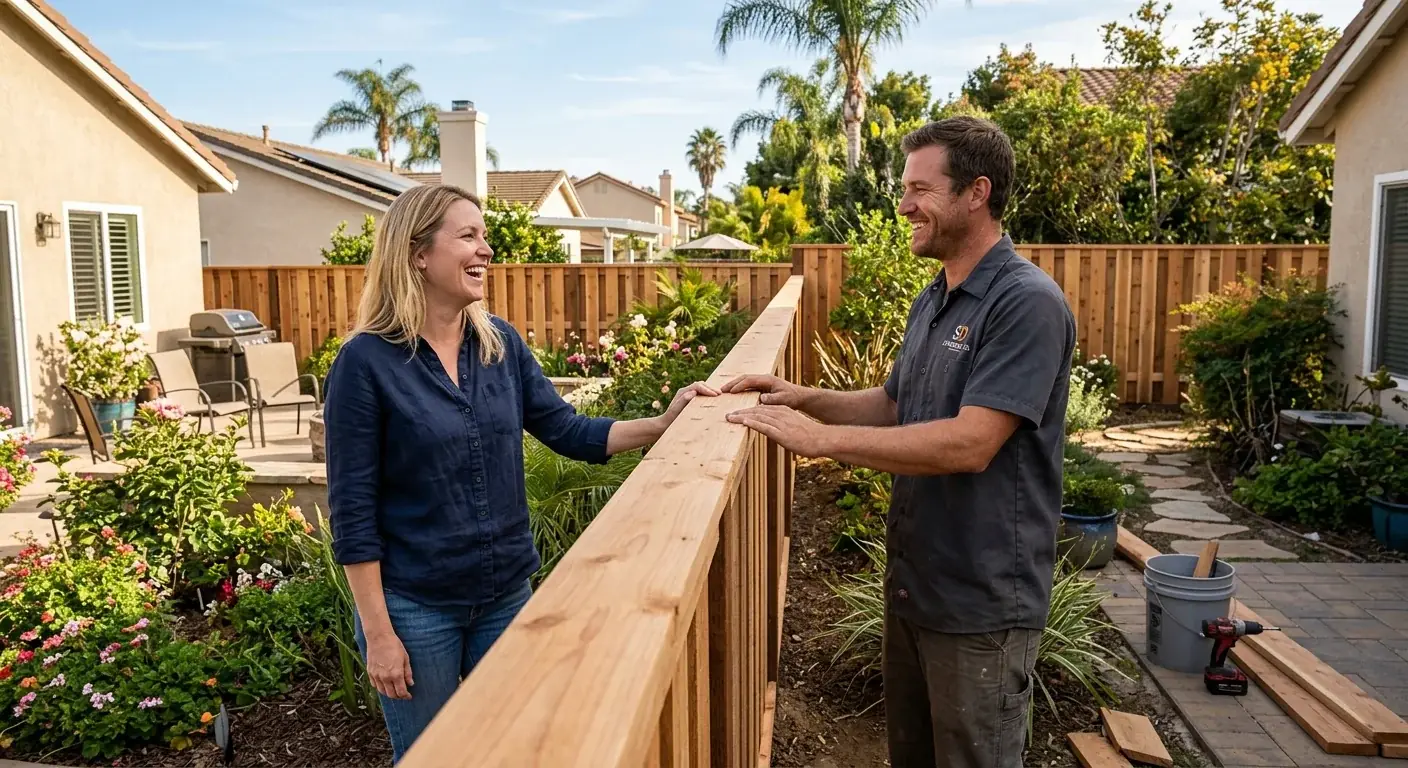
A good neighbor fence is a fence that looks finished on both sides, so neither homeowner gets stuck staring at exposed posts and rails. It hides the “back” of the fence by mirroring or alternating the pickets. In San Diego, the term also ties to California’s Good Neighbor Fence Act, which presumes adjoining owners split the cost of a shared boundary fence 50/50.
When you’re planning a new fence in San Diego, you probably want something that enhances your property without creating friction with your neighbors. That’s where the concept of a “good neighbor fence” comes in, offering a solution designed to be visually appealing and fair to everyone involved. Understanding what this type of fence entails can make your project smoother and keep your relationships strong.
The definition of a ‘good neighbor’ fence
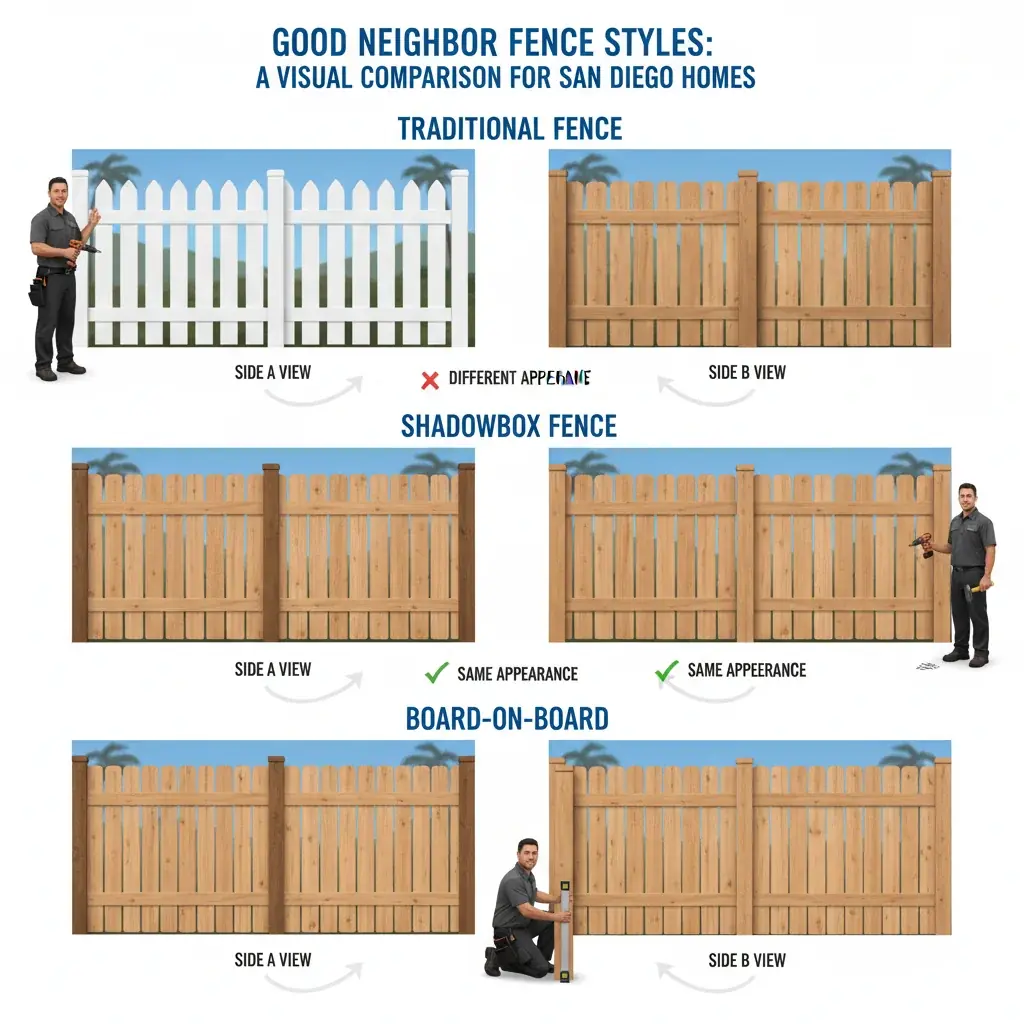
A good neighbor fence presents a finished face to both sides of the property line. On a traditional fence, one side shows the smooth pickets and the other shows the posts and rails. A good neighbor fence removes that “front” and “back” split, so both homeowners look at the same finished surface.
That matters in San Diego County, where lots sit close together and a shared fence is a daily view for two households. The logic is simple fairness: if both neighbors pay for the fence, both should get the good side. It also heads off the most common shared-fence argument before it starts, who gets stuck looking at the rails. The term itself isn’t a legal category under California law, but the cost-sharing rules behind it are, and we cover those below.
Fence styles that look good from both sides
While the primary goal is mutual appeal, several fence styles naturally achieve the “good neighbor” look without requiring excessive customization or extra effort. These designs typically involve alternating or mirroring components in such a way that there’s no single “ugly” side. Choosing one of these styles is often the simplest path to a truly balanced and neighbor-friendly fence.
One of the most popular and effective choices in San Diego is the shadowbox fence. This classic wood fence design features pickets installed on alternating sides of the horizontal rails. This creates a distinctive layered, three-dimensional effect that looks virtually identical from either property. When you observe a shadowbox fence, you’ll notice small glimpses through the staggered gaps, which also allows for some welcome airflow – a benefit in San Diego’s sunny climate. The key takeaway is that the alternating picket placement inherently provides a consistent visual experience for both neighbors, making it a quintessential good neighbor option.
Another excellent choice for achieving a uniform appearance is the board-on-board fence. This style provides complete privacy by overlapping pickets, ensuring no gaps. To make it a good neighbor fence, installers can apply boards to both sides of the rails, effectively sandwiching the fence framework. This means that while one side might have the vertical boards directly covering the rails, the other side will also present its own set of vertical boards, offering a completely finished and solid look. Both properties receive an equally substantial and attractive surface, guaranteeing neither neighbor feels like they’re looking at the “back” of the fence. For a more in-depth comparison of these two popular options and their specific advantages, you can explore our detailed guide on board-on-board vs. shadowbox fences in San Diego.
Beyond wood, certain modern materials also lend themselves well to this concept. Many vinyl and composite fences are manufactured with finished surfaces on both sides, offering a uniform aesthetic straight out of the box. Similarly, decorative metal fences, such as wrought iron or ornamental aluminum, are inherently dual-sided, providing an open, elegant look that is identical from either viewpoint. The core principle remains consistent: the chosen design should ensure that structural elements like posts and rails are either fully concealed or smoothly integrated into the overall aesthetic on both sides, ensuring visual equity for everyone.
Good neighbor fence vs. regular fence
A standard privacy fence shows the smooth pickets on one side and the posts and rails on the other. A good neighbor fence finishes both sides. Here’s how they compare.
| Feature | Good neighbor fence | Regular privacy fence |
|---|---|---|
| Appearance | Finished and uniform on both sides | Smooth pickets one side, exposed posts and rails the other |
| Privacy | Full privacy, balanced look | Full privacy, one-sided finished look |
| Common styles | Shadowbox, board-on-board, vinyl, wrought iron | Standard dog-ear or stockade |
| Labor and materials | More boards and tighter spacing, costs a bit more | Less material, lower cost |
| Cost sharing under CA law | Presumed 50/50 on the shared line | Presumed 50/50 on the shared line |
| Neighbor relations | Avoids the “good side” dispute up front | Often sparks a “who faces the back” argument |
San Diego fence prices vary by material, height, and site conditions. The ranges below reflect typical installed costs in San Diego County in 2026, for a standard 6-foot privacy fence on level ground. Coastal jobs near the ocean often run higher because salt air pushes homeowners toward vinyl or treated posts.
| Material | Installed cost per linear foot | Notes for San Diego |
|---|---|---|
| Pressure-treated pine | $25 to $40 | Budget option, needs sealing inland |
| Western red cedar | $30 to $55 | Popular, handles dry inland heat well |
| Vinyl | $40 to $70 | Finished both sides, best near the coast for salt resistance |
| Composite | $45 to $75 | Low maintenance, uniform both sides |
| Wrought iron or aluminum | $35 to $90 | Dual-sided by design, good for view lots |
The good neighbor upgrade adds roughly 10 to 25 percent over a basic one-sided fence, since board-on-board and shadowbox styles use more lumber. For an exact figure on your line, call us at (858) 925-5546 for a same-day estimate.
How to talk to your neighbor about a shared fence project
Embarking on a shared fence project requires thoughtful and proactive communication with your neighbor. Approaching the conversation correctly from the outset can pave the way for a smooth project, prevent misunderstandings, and preserve a positive relationship for years to come. Skipping this crucial step can lead to unnecessary friction or even legal disputes, which no one in San Diego wants.
Begin by initiating the conversation early, well before you’ve solidified your plans or engaged a contractor. A casual, friendly chat over the fence or a polite knock on their door is often the best start. Explain that you’re considering a new fence and, since it affects both properties, you wanted to discuss it with them to gather their input. Make it clear that you’re seeking their collaboration and cooperation, rather than simply informing them of a decision you’ve already made. This collaborative spirit is key.
When you do talk, come prepared with some preliminary ideas but maintain an open and flexible attitude. You might show them pictures of “good neighbor” fence styles, like shadowbox or board-on-board, explaining how these designs offer mutual benefits by looking great from both sides. Highlight the advantages for both homes, such as enhanced privacy, improved aesthetics, and the potential for increased property value. Discussing their preferences regarding style, material, and height is also important. This is a shared investment, and their perspective matters.
Next, address the sensitive topic of costs and how you envision sharing them. California law has specific provisions regarding shared fence expenses, which we’ll detail shortly. Having a preliminary idea of costs, perhaps from initial online research or a quick call to a local fence company, and expressing a willingness to negotiate can significantly ease this part of the conversation. Offer to get detailed estimates from reputable local fence companies, like Fence Pros San Diego, and share all proposals transparently. It’s wise to put your final agreement in writing, even if it’s a simple signed note outlining the agreed-upon style, cost-sharing, and timeline. This documentation protects both parties and serves as a clear reference if any questions arise later. A successful conversation leads to a shared vision and a beautiful new fence that truly benefits everyone.
California good neighbor fence law: who pays for a shared fence
The law that governs shared boundary fences in California is Civil Code Section 841, the “Good Neighbor Fence Act of 2013.” It sets a clear presumption: adjoining owners are equally responsible for the reasonable cost of building, maintaining, or repairing a fence that separates their properties. In most cases that means you and your neighbor split the cost 50/50.
However, the law isn’t just about splitting costs; it also outlines a specific process for notification. Before any work begins, the landowner intending to build or repair a fence must provide a 30-day written notice to their adjoining neighbor. This notice is vital and must include:
- A description of the problem or reason for the fence project.
- The proposed solution or type of fence to be installed.
- An estimate of the total costs involved.
- A proposed division of responsibility for those costs, typically 50/50.
This 30-day window allows your neighbor time to review the proposal, discuss it with you, and potentially object. If a neighbor objects to sharing the cost, they must present evidence that the cost is unreasonable, that the proposed work is unnecessary, or that the financial burden for the fence is disproportionately high compared to the benefit they receive from it. While the law encourages mutual agreement, it also provides recourse if an agreement can’t be reached, often through mediation or, as a last resort, small claims court. For a more exhaustive understanding of these nuances and specific local regulations in your San Diego community, we highly recommend consulting our comprehensive guide on San Diego property line fence rules.
Choosing to invest in a durable, high-quality, and aesthetically pleasing fence, especially a good neighbor style, can significantly enhance both properties and prevent future issues. When embarking on significant projects like a new fence installation, ensuring full compliance with local San Diego building codes and California state law is not just good practice but a legal necessity. Always partner with reputable, licensed contractors who are well-versed in these requirements. You can easily verify a contractor’s credentials with the Contractors State License Board (CSLB) by visiting cslb.ca.gov to confirm they are properly licensed and in good standing. This due diligence protects your investment and ensures your project meets all standards.
Good neighbor fence FAQ
Is a good neighbor fence required by law in California? No. California’s Good Neighbor Fence Act (Civil Code 841) governs who pays for a shared boundary fence, not its design. The dual-sided “good neighbor” style is a courtesy, though some HOAs and San Diego communities require a finished look on both sides.
Who pays for a shared fence in San Diego? California law presumes adjoining owners split the reasonable cost 50/50. A neighbor can push back if they show the cost is unreasonable or they get little benefit, like an undeveloped lot.
Do I have to give my neighbor written notice? Yes, if you want the law’s cost-sharing presumption to apply. You must give 30 days’ written notice describing the problem, the proposed fence, the estimated cost, and the proposed 50/50 split before work begins.
What’s the cheapest good neighbor fence style? Shadowbox cedar is usually the most affordable true good neighbor design. It uses alternating pickets, so both sides look the same without doubling the lumber a board-on-board fence needs.
How tall can a good neighbor fence be in San Diego? Most San Diego backyards allow fences up to 6 feet without a permit. Front-yard fences are typically capped near 3 to 4 feet. Always confirm with your city before building.
What does a good neighbor fence cost in San Diego? Expect $25 to $90 per linear foot installed, depending on material. Cedar and vinyl are the common picks, and the dual-sided finish adds roughly 10 to 25 percent over a one-sided fence.
When to call us
If you’re considering a new fence project or need to replace an existing one, especially a shared boundary fence, professional guidance makes all the difference. Our team understands San Diego’s unique property dynamics and local regulations, and we specialize in crafting beautiful, durable fences that enhance your home and build good neighbor relations. Call us at (858) 925-5546 for a same-day estimate.