A side-yard wood garden gate in San Diego has a different job than a street-facing entry leaf or a driveway pair. It has to match the fence, clear bins and wheelbarrows, and stay square in salt air or inland heat. Compare the opening, the swing, and the posts before anyone builds a new leaf.
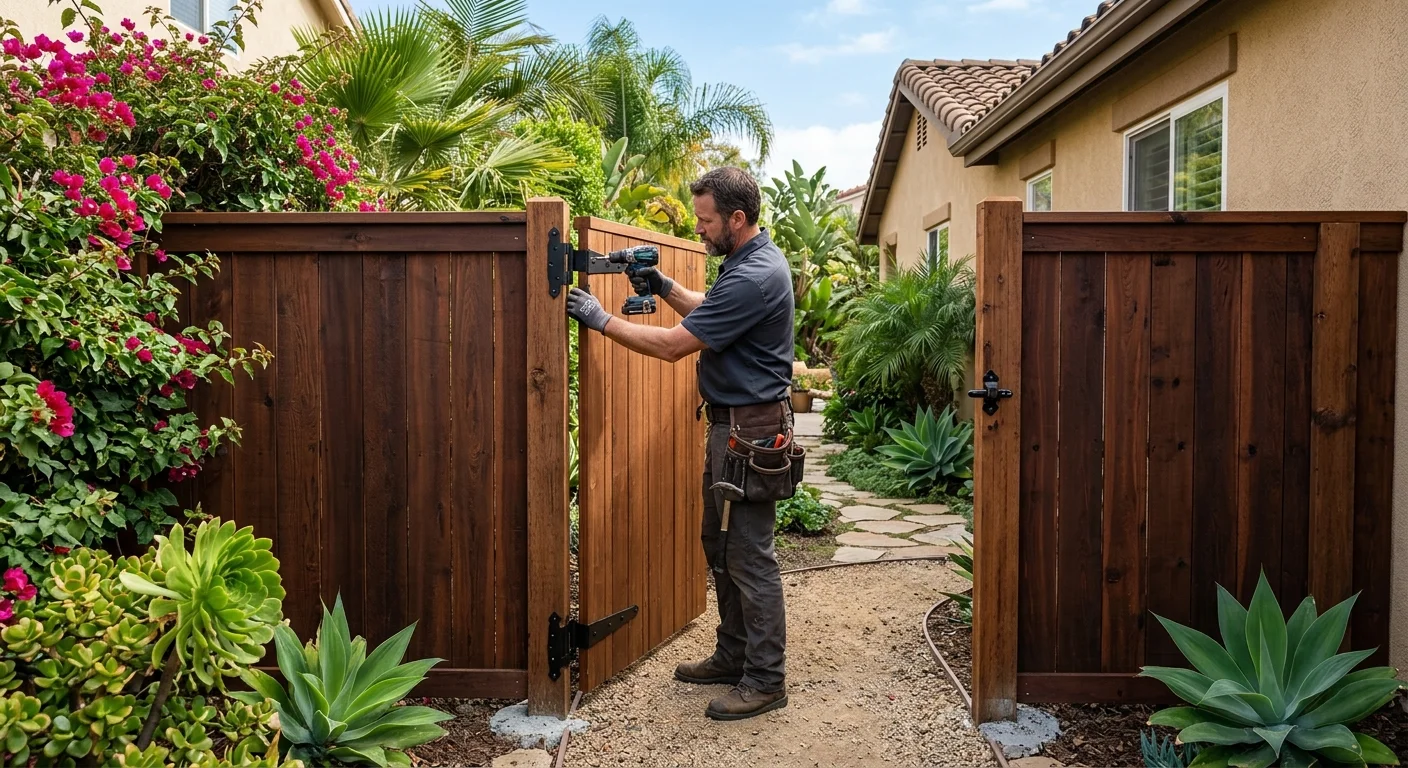
How a wood garden gate differs from a front entry or driveway gate
A wood garden gate sits in a fence line that already has a job. In North Park and Normal Heights, that is often a narrow side yard between bungalows, with trash cans, a hose bib, and a path to raised beds. In Chula Vista and National City, it is the cut-through from the driveway to the backyard. In Encinitas and Point Loma, it is the leaf that keeps dogs out of a coastal garden without looking like a street gate.
That is not the same as a front entry gate. An entry leaf faces the sidewalk, the HOA, and anyone walking past. It carries more hardware, more finish decisions, and more rules about height and look. A driveway pair is a vehicle opening. It needs clearance for cars, slope at the apron, and often automation. For the vehicle job in wood, see wood driveway gates. A garden gate is a pedestrian leaf in a wood fence, built to match pickets, rails, and stain so the opening does not read as a patch.
It also is not the same as a generic walkthrough gate. Walkthrough is the opening type: a person-sized cut in a fence. Wood garden gates are the material and setting: a wood leaf, usually matching a wood fence, usually on a side yard or garden path. Searchers mix those terms. The proposal should not. Write down where the gate sits, who uses it, and what has to pass through it.
San Diego County is not one climate. A garden gate in La Jolla takes salt and marine layer. The same leaf in El Cajon or Santee takes heat, clay soil movement, and Santa Ana winds. Coastal hardware rusts. Inland posts lean when soil shrinks. A contractor who quotes a garden gate like a front entry, or like a kit from a catalog, will miss those local loads.
If that opening is also a pool barrier, stop treating it as a garden leaf. California Health and Safety Code 115923 sets enclosure rules for covered private pools, including height, ground clearance, opening size, and self-closing, self-latching gates that swing away from the pool. Confirm with the building department whether that side-yard opening is part of the enclosure. The licensed fence contractor should say so in writing.
What width, swing, and matching fence details belong in the proposal
There is no verified county-wide “typical” outdoor gate size. Garden openings are built to the posts that already exist, or to posts a contractor will set. Measure the clear opening between posts at the top and the bottom. Write both numbers on the proposal. A leaf cut to the top measurement will bind at the bottom on a sloped East County side yard.
Width is a use question, not a style question. A wheelbarrow, a mower, and two trash bins need more than a person turning sideways. On older lots in University Heights and Kensington, the side yard is tight. The leaf may have to swing the only direction that does not hit a stucco wall, a water heater closet, or a meter. On wider Rancho Bernardo and Carmel Valley lots, a double leaf can split the opening so each side stays lighter. Ask the contractor to mark swing direction, swing arc, and what the leaf hits at 90 degrees.
Matching the fence is the part catalog photos skip. A new garden gate next to an old wood fence looks wrong if the picket profile, rail height, cap, and stain do not line up. Ask for the same species as the existing run, or a written note that the species will differ and how they will finish it. Claims about which wood “lasts longest” are not something this site can verify. Matching what is already on the lot is the comparison that matters.
The proposal should list, as separate lines:
- Clear opening width at top and bottom
- Leaf height and how it lines up with adjacent pickets
- Single or double leaf
- Swing direction and what the path must clear
- Hinge side, latch side, and latch height
- Whether posts are reused, sistered, or replaced
- Whether the adjacent fence panels are in the same job
- Finish: stain, paint, or left to weather, matching the run
Ground clearance matters on irrigation-heavy side yards in Vista and Oceanside. Spray hits the bottom rail every night. A leaf that drags will rot at the cut end. A leaf that sits too high lets pets out. Have the contractor set that gap from the finished grade, not from a photo.
If the fence sits in the City of San Diego, publicly posted Municipal Code Chapter 14, Article 2, Division 3 (July 2026 publication) lists fences below 7 feet as no permit under that division, and 7 feet or greater as Building Permit, Process One. Other approvals, design rules, and coastal overlay caveats still apply. Exemption is not the same as zoning compliance. In unincorporated county areas, County PDS070 (revised 2023-01-01) lists a permit exemption for fences and walls no higher than 6 feet if the work is zoning compliant. Confirm the current rule with the city or County PDS for that address. Do not assume a garden gate is exempt because it is “just a gate.”
Why sag, latch line, and post condition need one inspection
A sagging garden gate is rarely only the leaf. The latch misses because the hinge post moved, the latch post leaned, the diagonal brace failed, or the boards cupped. Looking at one of those in isolation produces the wrong quote.
Have the contractor check the leaf, both posts, and the latch in one visit. Start at the hinge post. Push it. Look at the soil line. Side-yard posts in East County clay lean after a wet winter and a dry summer. Coastal posts in Encinitas rot at grade when irrigation and salt sit on the same wood. If the post moves, a new leaf on those hinges will sag again.
Then the latch line. Close the gate and look at where the bar or catch meets. A miss at the top with a tight bottom is a post or hinge problem. A miss that changes with the weather is often a warped wood gate. Cupping and twist show up fast on west-facing leaves in inland heat. Do not let a hardware-only quote paper over a twisted frame.
Then the leaf itself. Look for a broken or missing diagonal, split rails, and hinge screws that have ovaled out of the stile. A garden gate is a swinging rectangle hanging from one post. When the brace no longer carries the load, the latch side drops. That drop is visible from the alley in many South Bay lots before anyone notices it from the patio.
Write the inspection as one finding, not three. Example: hinge post soft at grade, latch post still plumb, leaf racked half an inch. That sentence tells you whether the job is hardware, a new leaf, post work, or all three. Splitting those into separate visits is how homeowners pay twice.
If the gate is on a shared side fence, California Civil Code 841 may apply. Adjoining landowners are presumed to share equally in reasonable costs of construction, maintenance, or necessary replacement of a dividing fence, unless a written agreement says otherwise. A 30-day written notice with the problem, the proposed work, estimated costs, cost-sharing, and timeline is required before incurring those costs. A garden gate in a boundary run is still part of that fence. Confirm with the neighbor in writing before the contractor starts.
When repair and a new leaf deserve separate quotes
Repair and a new leaf are different scopes. Mixing them in one lump line hides the part that will fail.
Ask for a repair quote when the posts are sound, the leaf is still square, and the miss is hinges, a latch, or a single broken board. Ask for a new-leaf quote when the frame is racked, the boards are cupped past a clean close, or the brace is gone. Ask for a post quote when either post moves. Those three numbers let you choose. One combined number does not.
A new leaf on a rotten hinge post is wasted work. A new latch on a twisted leaf will miss next month. A repaired leaf against a fence that will be replaced in the same season will not match. If the adjacent wood fence is already failing, put the gate in the fence replacement quote, not as a standalone patch.
California Business and Professions Code 7048 exempts some casual, minor work under $1,000 in aggregate, with limits: the work cannot be split to dodge the threshold, cannot require a building permit, and the person cannot advertise as a contractor or hire others to do it. A wood garden gate plus posts plus matching panels often sits over that line. Check the licensed contractor on the CSLB license lookup. A C-13 fencing classification covers constructing, altering, and repairing fences and gates. It does not cover masonry walls.
This site does not publish a typical price for putting up a wooden gate. No verified market rate for that job sits in our claims ledger. Cost depends on opening width, whether posts are replaced, hardware, matching fence work, access down a side yard, and finish. Ask each contractor for line items, not a single number. Compare those lines. Do not compare a repair of a latch to a full leaf and two posts.
If you already know the leaf is the problem and the posts are fine, still get the posts written down as “reused, found sound.” That note protects you when the next contractor wants to replace everything.
What to compare before choosing a gate contractor
Compare the written proposal, not the conversation at the fence.
Look for a C-13 fencing contractor, then verify the license on the CSLB site. Every fence contractor in our network is licensed and insured. The homeowner still contracts with that pro directly. Fence Pros San Diego is a referral service. We do not hang gates, own trucks, or set prices.
Score each proposal on the same list:
- Opening measurements at top and bottom
- Swing direction and clearance notes
- Single vs double leaf, and why
- Post reuse or replacement, with soil and irrigation notes
- How the leaf will match existing pickets, rails, and stain
- Hardware described, not branded as a promise
- Repair vs new leaf as separate lines
- Whether gate installation is only the leaf, or the leaf plus adjacent panels
- Permit language that names the city or unincorporated county, not a guess
Walk the swing path with the contractor. On a sloped Lakeside or Jamul side yard, a leaf that looks fine on paper will hit grade. On a coastal lot, ask how they treat hardware in salt air. On an HOA lot in Scripps Ranch or 4S Ranch, ask who submits the drawing. None of that is a catalog option. It is the job.
Skip anyone who quotes from a photo without standing at the posts. Skip a lump price with no post line. Skip a “best wood” pitch with no match to the fence you already have. The comparison that holds up is local: Encinitas salt is not El Cajon heat, and a North Park side yard is not a Rancho Santa Fe garden wall.
Bring the same notes to each visit. Width, swing, posts, latch line, and whether this opening is also a pool barrier. The contractor who writes those down is the one whose quote you can actually compare.
When to call us
Call when the garden gate sags, the latch misses, the posts move, or you need a new wood leaf that matches an existing fence. A licensed fence contractor should inspect the leaf, latch, and both posts as one job. Call us at (858) 400-4906 and we’ll connect you with a licensed fence contractor.