Cedar and redwood are both naturally decay-resistant softwoods, and both make good fence lumber. The differences that actually matter show up in the boards themselves, not in which species name is on the invoice.
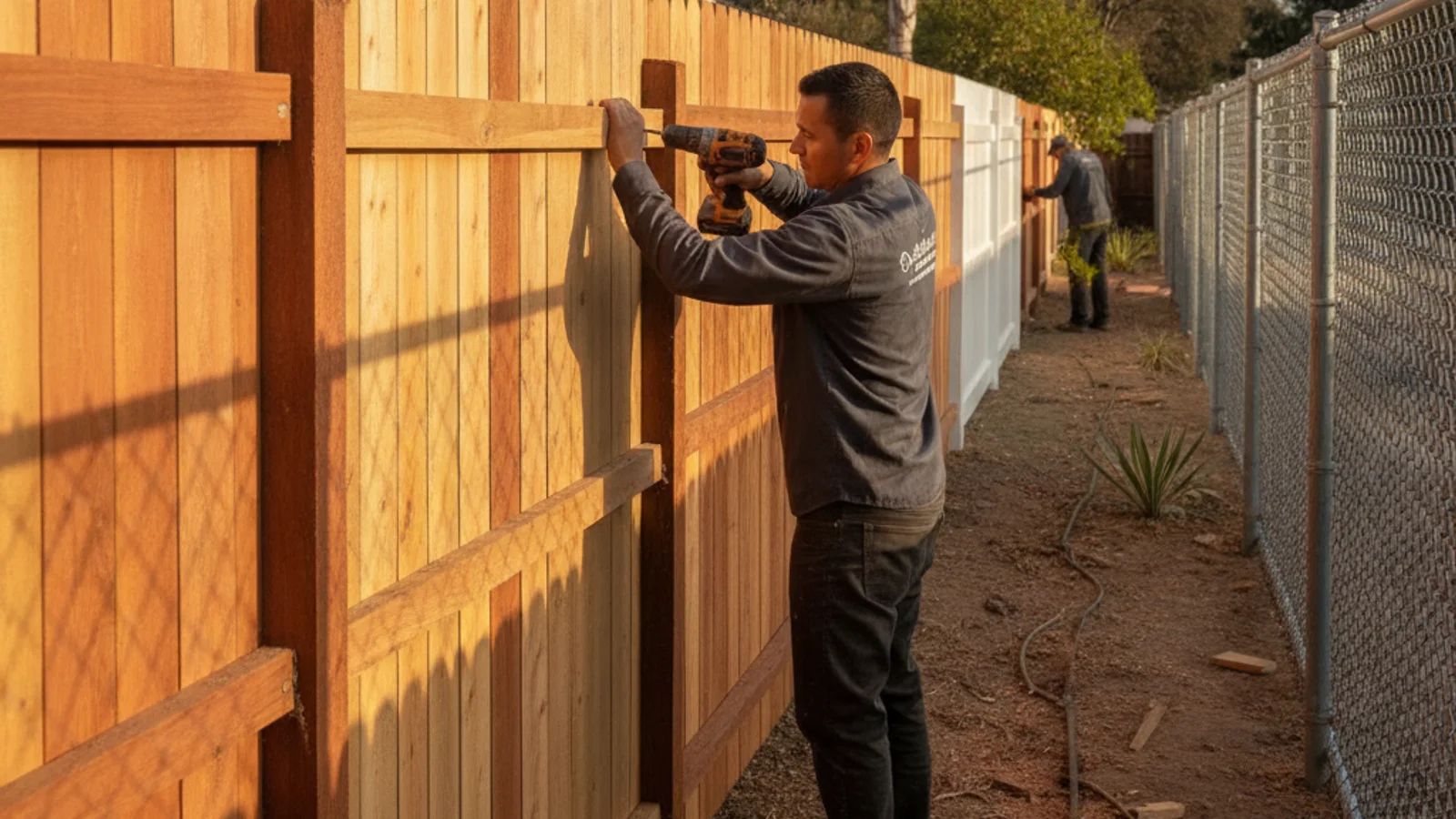
If you’ve already read our breakdown of the best wood for a San Diego fence or our cedar-specific pros and cons, this post goes one step further and puts cedar and redwood directly against each other, including the one detail most homeowners never think to ask about: whether the boards they’re quoted are heartwood or sapwood.
Heartwood vs. sapwood: the detail that matters more than species
Both cedar and redwood trees have two layers of wood. Heartwood is the older, denser wood from the center of the tree, and it carries the natural oils and extractives that give both species their decay and insect resistance. Sapwood is the newer, outer wood, lighter in color, and it has little to none of that natural protection.
A board cut mostly from heartwood, in either species, resists moisture and insects meaningfully better than a board cut mostly from sapwood. This is true within a single species, which means a lower grade of redwood with more sapwood content can underperform a higher grade of cedar with more heartwood, and vice versa. When you’re comparing two bids that quote different species, ask what grade of lumber each one is actually specifying. “Redwood” or “cedar” on a quote without a grade tells you the species, not what you’re getting.
Natural decay resistance: how the two species compare
Cedar’s resistance comes primarily from thujaplicins, natural compounds in the heartwood that resist fungal decay and deter some insects. Redwood’s resistance comes from tannins concentrated in its heartwood, which serve a similar protective function through a different chemical pathway.
Neither species has a documented, verifiable lifespan figure that applies consistently across installations, since actual performance depends on the specific board’s heartwood content, the local climate, ground contact, moisture exposure, and maintenance over time. What’s better documented is that both species, in heartwood-grade lumber, meaningfully outperform non-decay-resistant woods like standard pine in resisting rot and insect damage without chemical treatment.
Availability in the San Diego market
Redwood is grown along the Northern California and Southern Oregon coast, which keeps it more regionally available to California lumber suppliers than cedar, most of which is shipped in from the Pacific Northwest or western Canada. That regional proximity sometimes gives redwood a supply and pricing advantage in California markets, though availability shifts with lumber market conditions and won’t necessarily favor one species at any given time.
Both species are commonly stocked by San Diego-area fence suppliers, and most fence pros in the county can source either one. If a specific grade or board width isn’t in stock, lead time can vary, which is worth asking about if you’re working toward a particular timeline.
Coastal salt air vs. inland heat
Neither cedar nor redwood is immune to San Diego’s climate extremes, but they meet different conditions differently. In coastal zones like La Jolla, Del Mar, and Point Loma, salt-laden air and marine layer moisture create near-constant low-level dampness that tests a wood’s decay resistance over the long run. Heartwood-grade boards in either species handle that exposure better than sapwood-heavy boards, but neither is a substitute for periodic maintenance in a coastal environment.
Inland areas like El Cajon, Ramona, and Escondido swing the other direction, with intense summer heat and low humidity that dries and stresses wood fiber, making boards more prone to checking and warping if they weren’t properly seasoned before installation. Redwood is often described as slightly more dimensionally stable under heat-driven drying, though the difference is modest and grade matters more than species in most real-world comparisons.
How each species takes stain
Cedar has a tighter, more uniform grain that tends to take stain evenly across a board, which is part of why it’s a common choice when a rich, consistent color is the goal. Redwood’s grain can be more variable board to board, which sometimes produces more visible color variation after staining, though many homeowners like that natural variation as part of the look.
Both species should be allowed to dry fully after installation before staining, and both benefit from a UV-protective stain given how much direct sun most San Diego fence lines see. If you’re deciding between stain and paint generally, our painting versus staining guide covers that decision in more depth.
How to compare two bids quoting different species
When one bid quotes cedar and another quotes redwood for the same wood fence project, the species name alone isn’t enough to compare them. Ask each contractor for the specific grade being quoted, since heartwood content varies by grade within both species. Ask whether the boards are kiln-dried or air-dried, since that affects how much they’ll shrink and check after installation.
Ask what finish, if any, is included and whether it’s applied by the contractor or left to the homeowner. And ask to see a sample board if possible, since grain, color, and heartwood proportion are easier to judge in person than from a spec sheet. A contractor who can speak specifically to grade and heartwood content is generally quoting more carefully than one who’s only naming the species.
Fasteners can change the finished color
Cedar and redwood contain tannins that can react with plain steel hardware. Around a fastener head, the first sign may look gray or blue-black. Moisture can carry that discoloration down the board in narrow streaks. Orange rust marks may also appear as the steel corrodes. On pale cedar, those marks can stand out quickly. Redwood’s deeper color may hide them at first, not prevent them.
This matters most where boards stay damp. Coastal salt air and the marine layer can keep hardware exposed to moisture. Inland fences face sharp drying during East County heat. Santa Ana wind events also put connections under added stress. The wood species doesn’t solve any of those hardware choices.
Read each bid for the exact fastener and connector specification. “Exterior fasteners” isn’t a useful description by itself. Ask the contractor to name the fastener material and coating. Do the same for brackets, hinges, latches, post caps, and gate hardware. A bid should also clarify whether visible fasteners will match throughout.
Look closely at mixed-metal connections. A compatible screw won’t help if the bracket around it stains. Cut ends and field-drilled holes also need the intended hardware. Gates deserve extra attention because their connections move during regular use.
When two bids name different lumber, compare their hardware lines side by side. One may include a careful connector package while the other stays vague. That difference can affect appearance and how the fence feels in use. The prettier board sample won’t show what happens around a poor fastener.
Ask the contractor you’re matched with to explain every exposed metal choice. If the bid doesn’t identify one, request written clarification. Cedar versus redwood is only half the material decision. The fastener and bracket specification deserves equal attention.
Keep the lowest boards away from wet soil
The bottom edge usually sees the hardest moisture exposure. Soil can hold water against boards after irrigation or rain. Sprinkler spray can repeat that wetting during otherwise dry weather. Neither cedar nor redwood should sit in soil or regular sprinkler spray. Natural decay resistance doesn’t make constantly damp boards a good detail.
A kickboard, sometimes called a rot board, separates the main pickets from lower-edge wear. It takes the splash, soil contact, and trimming damage first. That can make the lower section easier to inspect and replace. Still, its material and placement need to appear on the bid. “Wood fence” doesn’t explain what touches the ground.
Ask whether the design includes a kickboard. Then ask which species and grade it uses. The bid should show how the pickets meet that board. It should also identify the intended separation from soil, mulch, or hardscape. Don’t accept a drawing that leaves the bottom detail unclear.
San Diego County lots create different concerns. Inland East County properties may have decomposed granite along the fence line. Lots near the coast and central city may contain expansive clay. Ask the contractor how those site conditions affect drainage and placement. The lower detail needs to fit the actual yard, not a generic sketch.
Walk the line before choosing cedar or redwood. Note sprinkler heads, downspout outlets, low spots, raised planters, and piled mulch. Ask how water will move away from the boards. If a sprinkler hits the fence, redirect that spray. A decay-resistant board still shouldn’t serve as a drainage barrier.
Compare bids at the bottom, not only at eye level. A clear kickboard detail may matter more than a species upgrade. The contractor you’re matched with should explain what contacts soil and why. Get that explanation in writing where the grade changes across the property.
Put the shared-line decision in writing
A shared property line changes the cedar-versus-redwood decision. Your neighbor may prefer the lower bid or a different appearance. Start by separating the boundary need from optional upgrades. Then compare the same layout in each species, with matching grades and hardware.
California Civil Code section 841 frames that conversation. Adjoining landowners share responsibility for maintaining the boundary between their properties. For a dividing fence, the law presumes equal benefit. Without a written agreement, it also presumes equal responsibility for reasonable construction, maintenance, or necessary replacement costs.
That doesn’t mean one owner can choose any upgrade and send half the bill. The statute’s focus on reasonable costs still matters. A written agreement can replace the equal-cost presumption. Record the selected species, grade, finish, hardware, and cost split. Also state how later maintenance decisions will be handled.
Before incurring shared-fence costs, section 841 requires 30 days’ advance written notice. The notice must describe the fence problem and proposed solution. It must include estimated costs, the proposed cost split, and the planned timeline. A casual text may not cover those required details. Keep the formal notice clear and complete.
Local preferences can pull the decision in different directions. A coastal neighbor may focus on staining near exposed hardware. An East County owner may care more about drying and movement. One side may face the street while the other faces a yard. Agree on which face, finish, and kickboard detail each property will see.
If your neighbor wants the cheaper species, ask for comparable written bids. Price only means something when grade, fasteners, gates, and finish match. The contractor you’re matched with can prepare options, but the owners decide. Fence Pros San Diego only makes the referral. You’ll contract and pay the independent contractor directly.
Resolve the species choice before authorizing work. If ownership, boundary location, or legal responsibility is disputed, consult the proper professional before proceeding.
Frequently asked questions
Is redwood always more expensive than cedar, or the other way around?
Pricing shifts with lumber market conditions and regional supply, and there’s no fixed rule that one species consistently costs more than the other. Get current quotes for both if cost is a deciding factor.
Can cedar and redwood be mixed on the same fence?
It’s possible but uncommon, since the two species weather and take stain somewhat differently over time, which can make a mixed fence look inconsistent as it ages.
Does a higher grade always mean more heartwood?
Generally yes, since grading standards for both species factor in heartwood content, but grading terminology differs by supplier and species, so it’s worth asking the contractor to explain what a specific grade means for the boards being quoted.
When to call us
Comparing cedar and redwood bids accurately means asking about grade and heartwood content, not just the species name, and a licensed pro can walk you through what a specific quote actually includes. Call us at (858) 400-4906 and we’ll connect you with a licensed fence contractor.