A cracked wood fence post needs a whole-section assessment before you choose reinforcement or replacement. Check the crack, post movement, rail separation, and footing together. A fence pro can then explain whether the damage appears isolated or affects connected parts.
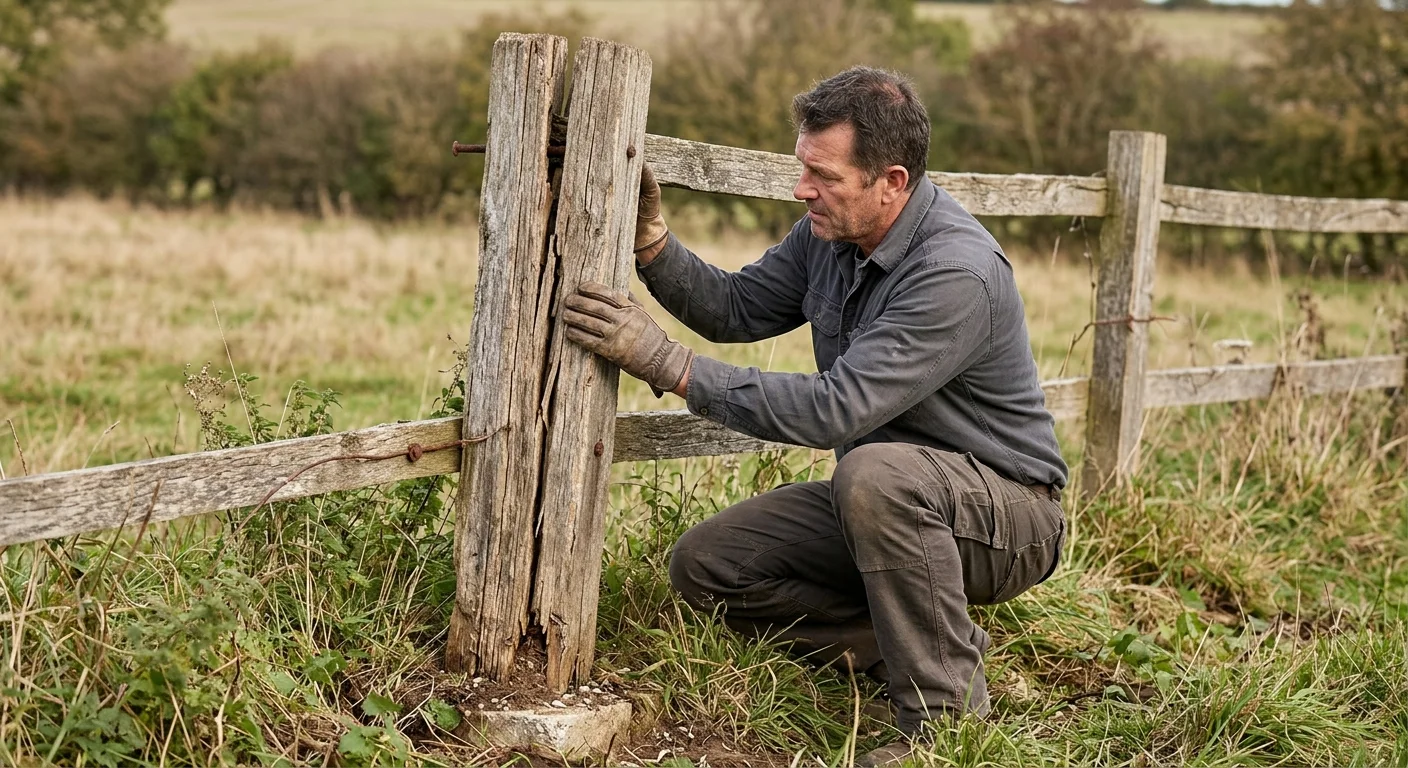
What cracks, movement, and rail separation can indicate
A visible crack gives you a starting point, not a complete diagnosis. Its location and path matter. So does the way the post behaves when the surrounding fence is observed.
Begin by looking at the crack without opening or altering it. Record where it starts and ends. Note whether it stays on one face or appears on another side. Check whether it reaches a rail connection, fastener, knot, or the base of the post.
Next, view the fence from several steps away. A split wood fence post may still appear aligned. Another post may lean, twist, or sit differently from neighboring posts. Movement near the footing deserves separate attention from flex higher on the post.
Look at both rails connected to the damaged post. A growing gap, shifted fastener, or separated rail can indicate that the problem extends beyond the visible crack. Nearby boards may also look uneven because the rail has changed position.
The setting belongs in your notes. A coastal North County property in Oceanside or Encinitas won’t present the same site conditions as every inland yard. Escondido, El Cajon, Chula Vista, and central San Diego properties also vary by grade, irrigation placement, and exposure around the fence. Document what’s actually present rather than diagnosing from the ZIP code.
Don’t label the crack cosmetic or structural from a photo alone. Use the visible signs to show a fence pro where a closer inspection should begin.
Why the post, footing, and connected section need one inspection
The cracked post is connected to rails, boards, fasteners, and a footing. Assessing only the exposed split can leave the scope unclear. The contractor should inspect how those parts relate at the damaged location.
Ask the pro to examine the full visible post, from its top to the point where it meets the ground or footing. The crack may change direction along the post. It may also cross a rail connection or disappear behind a fence board.
The footing needs its own observations. Visible separation between the post and footing, movement at the base, or a change in the surrounding ground can affect the proposed scope. Our guide to repairing fence post footings in San Diego explains why footing work should be described separately.
The connected section includes both adjoining spans. A pro should look for rail gaps, loose connections, shifted boards, and alignment changes. If a gate hangs from the post or closes against it, include the gate in the assessment. Its position can help document what has changed.
The neighboring posts provide useful comparison points. Ask the contractor to note whether the problem appears limited to one post or continues into the next section. That distinction can change what appears in a proposal.
A fence post repair and replacement assessment should identify each affected component. “Fix cracked post” isn’t a clear scope by itself. You need to know whether the proposal covers the post, footing, rails, boards, hardware, gate alignment, or only one of those items.
When reinforcement and replacement each deserve a proposal
Reinforcement and replacement are different scopes. Either one deserves a written explanation tied to the conditions found onsite. The proposal shouldn’t depend on the crack’s appearance alone.
A proposal to repair a cracked fence post through reinforcement should identify the material that would remain. It should explain where the reinforcement would connect and which observed problem it addresses. If the post moves, the proposal should state whether that movement comes from the post, its footing, a connection, or an issue that still needs confirmation.
Replacement deserves consideration when the contractor documents why keeping the existing post isn’t the preferred scope. That explanation might reference the crack’s path, a separated rail connection, movement at the base, or damage found around the footing. Ask which connected materials must be removed or reset during the work.
Don’t ask only, “Can this be repaired?” Ask what the proposed repair includes and what condition could change the recommendation. A contractor may need to expose a concealed connection before confirming the final scope. That possibility should be stated rather than hidden behind a vague repair label.
Our guide to fence post repair versus replacement can help you organize that decision. It doesn’t replace an onsite assessment of this post.
Avoid comparisons based on promised remaining service life. That figure hasn’t been confirmed for your post. Compare documented damage, included components, exclusions, and the contractor’s reason for recommending each approach.
A clear proposal to replace a cracked fence post should also address the connected section. Replacement isn’t complete as a written scope if it ignores affected rails, boards, hardware, or the footing decision.
What photos and measurements help a fence pro assess damage
Good photos help a fence pro understand the problem before an onsite inspection. They don’t establish the final diagnosis. Capture enough context to show how the crack relates to the post and fence.
Start with a wide photo of the entire connected section. Include the posts on both sides when possible. Take another image along the fence line so changes in alignment are visible.
Then photograph the damaged post from each accessible side. Include the full post in one frame. Add close views of the crack’s top, middle, and bottom. Don’t pry the split apart or remove attached material for the picture.
Photograph these nearby areas too:
- Each rail connection at the cracked post
- Any visible gap between a rail and post
- The post where it enters the ground or footing
- The visible footing and surrounding surface
- Boards or panels that have shifted
- A connected gate and its closed position
Place a ruler or tape beside the crack when you can do so without changing the fence. Record the crack’s visible length and widest accessible opening. Measure any rail gap and note where you took that reading. The measurement is a reference for the contractor, not proof of severity.
A level photo can also help document alignment. Hold the reference beside the post without pushing it. If the post moves during ordinary gate use or light contact, record a short video from a stable position. Don’t shake the fence to create movement.
Label the photos with their location. “Backyard post beside the east gate” is more useful than “broken fence.” For larger San Diego County properties, add a wide photo showing the route to that section. Keep landscaping, slopes, walls, and nearby irrigation visible when they surround the damaged post.
How to compare repair scopes without attempting a structural fix
Compare proposals against the same set of observations. Give each contractor the same photos, measurements, and description. Point out any movement, rail separation, gate change, or footing concern you noticed.
Each proposal should clearly identify the intended outcome and included work. Look for separate descriptions of the post, footing, rails, boards, fasteners, and gate. If an item isn’t affected, the contractor can say so. Silence leaves you guessing.
Ask these scope questions before choosing:
- Is the proposal for reinforcement, replacement, or further assessment?
- Which existing materials will remain?
- Which connected parts will be removed or reset?
- Is footing work included, excluded, or still undetermined?
- How will affected rails and boards be reconnected?
- Does the scope include a nearby gate?
- What concealed condition could change the proposed work?
- Who handles any added work if another damaged component appears?
Don’t cut the post, add braces, drive fasteners, or disturb the footing just to compare ideas. Those changes can hide the original condition and make proposals harder to match. Keep your role focused on documentation and questions.
For damage extending beyond one post, review the broader fence repair and restoration service. The useful comparison is the boundary of each scope. One contractor may address only the post, while another may include the connected span. Make sure the written details explain that difference.
Confirm the contractor’s license through the official California Contractors State License Board lookup. Fence Pros San Diego is a referral service. We match customers with licensed, independent local fence professionals. You’ll contract with and pay the selected professional directly.
When to call us
Call when the crack reaches a connection, the post moves, rails separate, or the footing also needs assessment. Call us at (858) 400-4906 and we’ll connect you with a licensed fence contractor.