Fences in La Jolla wear differently than fences five miles inland, and repairs there run into problems most of San Diego County never sees. Salt air, bluff-edge wind, and older housing stock all shorten the list of what actually fails first.
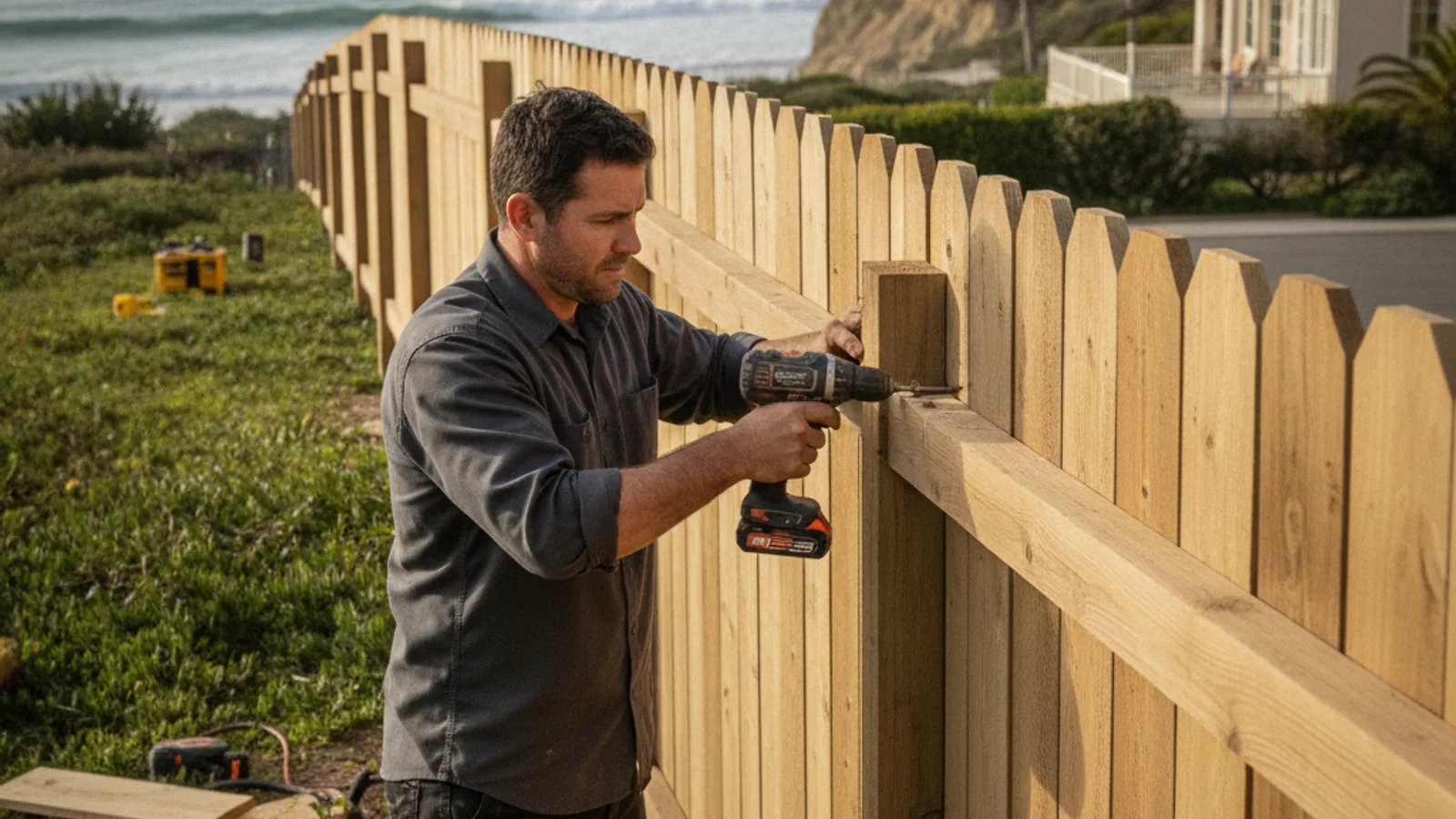
La Jolla is a community within the city of San Diego, not a separate municipality, so any permit question runs through City of San Diego Development Services rather than a local La Jolla planning office. That distinction matters once a repair grows into something that touches the fence’s footprint or height.
Salt air is the biggest difference, and it targets hardware first
Fences a mile from the ocean in La Jolla Shores or along the bluffs near Bird Rock take in far more salt-laden moisture than the same fence would inland. Salt air doesn’t rot wood the way standing water does, but it accelerates corrosion on anything metal: hinges, gate latches, screws, and the brackets that hold rails to posts. A wood fence that looks structurally sound can still have a gate that won’t latch or hinges that have rusted through, simply because the hardware aged years faster than the wood around it.
This is why a fence repair estimate in La Jolla often centers on hardware replacement even when the panels themselves are fine. Standard zinc-plated screws and hinges corrode fast this close to the water. Stainless steel or marine-grade hardware costs more up front but holds up substantially longer, and it’s worth asking any contractor bidding the job whether they’re specifying it or defaulting to standard fasteners. Our breakdown of salt air and coastal fence hardware goes deeper on which materials actually hold up near the water.
Bluff-adjacent wind adds a structural factor inland fences don’t face
Properties along the coastal bluffs, from the Cove up through Bird Rock and La Jolla Farms, sit in a wind pattern that inland San Diego neighborhoods simply don’t experience. Sustained onshore wind and gusts off the bluff edge put steady lateral load on tall fences and gates, which shows up over time as loosened posts, racked panels, or gates that swing and slam instead of closing cleanly. A repair that only replaces the visibly broken part without addressing why the wind keeps stressing that same section tends to fail again within a season.
Older housing stock means older fences, often with materials no longer standard
Much of La Jolla’s housing predates the newer developments common in North County or East County, and that shows up in the fences too. Older wrought iron with decorative ironwork, aging stucco-topped block walls, and wood fences installed decades ago under different building standards are all more common here than in newer subdivisions. Matching a repair to an older fence’s existing style, especially decorative iron or a specific wood profile, sometimes takes more sourcing time than a straightforward panel swap on a newer standard fence.
Approval requirements could not be confirmed
We couldn’t confirm a specific approval rule for La Jolla fence repairs from the approved primary sources. We also couldn’t confirm that changes to height, footprint, or location follow a different review path than a like-for-like repair. Before work starts, ask City of San Diego Development Services what review, if any, applies to the parcel and proposed scope. Our guide to La Jolla’s fence rules and styles covers the permitting side of a full project in more depth.
Canyon edges and steep lots make the labor harder, not just the material
Several La Jolla neighborhoods sit on steep lots or back onto canyon edges, which changes how a repair crew actually gets to the fence. Equipment that would roll straight to the back fence on a flat inland lot sometimes has to be carried in by hand on a sloped or terraced property, and a fence along a canyon rim may need careful footing work to avoid disturbing already-unstable slope soil. That access difficulty is a real part of what a contractor is pricing when a bid on a La Jolla repair looks different from the same repair job inland.
When repair still makes sense on a high-end coastal fence
Homeowners in La Jolla often have more invested in their fence than a standard vinyl or chain link installation elsewhere in the county, custom ironwork, glass panel sections, or hardwood chosen to match a specific architectural style. That higher investment usually tips the decision toward repair over replacement when the damage is isolated: a single corroded hinge, one section of failed hardware, or a post that’s loosened but not cracked. Replacing an entire custom run to fix a localized hardware failure rarely makes sense financially or aesthetically, since matching materials exactly can be harder than repairing what’s already there.
Full replacement becomes the better call when the underlying material itself, not just the hardware, has failed across multiple sections, or when repeated hardware failures point to a design that was never suited to this level of coastal exposure in the first place. A fence pro assessing an older ironwork fence, for instance, may recommend swapping in marine-grade hardware throughout during the next repair cycle rather than waiting for each hinge to fail one at a time.
What to ask before approving a coastal repair
| Ask the contractor | Why it matters in La Jolla specifically |
|---|---|
| Hardware grade being used | Standard fasteners corrode fast this close to salt air |
| Whether the repair changes height or footprint | Helps describe the proposed scope when checking approval requirements |
| Access plan for sloped or canyon-edge lots | Affects labor time and equipment cost |
| Sourcing for matching older materials | Decorative iron and older wood profiles aren’t always stock items |
Frequently asked questions
Does living in La Jolla mean I need a separate city permit from San Diego?
No. La Jolla is a community within the city of San Diego, so permits for fence work go through City of San Diego Development Services, the same authority that covers the rest of the city.
Why does my gate hardware fail faster in La Jolla than it did at my old inland house?
Salt-laden coastal air corrodes standard metal hardware, hinges, latches, screws, much faster than inland air does. The wood or panels themselves often outlast the hardware holding them together.
How do I check whether approval is needed to repair a damaged fence section?
We couldn’t confirm a specific approval rule for La Jolla fence repairs from the approved primary sources. Ask City of San Diego Development Services what review, if any, applies to the property and proposed work before starting.
Is fence repair more expensive in La Jolla than elsewhere in San Diego?
Labor and hardware choices both play a role, and access on steep or canyon-edge lots can add time a flat inland lot wouldn’t require. Get a written, itemized quote so you can see what’s driving the number rather than comparing a single total.
When to call us
A fence repair near the coast is worth a professional look, especially if hardware corrosion, bluff wind, or lot access are part of the picture. Have your property’s approximate distance from the water, the fence’s age and material, and photos of the damaged section ready when you call. Call us at (858) 400-4906 and we’ll connect you with a licensed fence contractor.