A Carlsbad wood fence does not age as one city. West of Interstate 5, salt, lagoon air, and tight beach lots drive the stain questions. East of the freeway, hotter sun, drier yards, and HOA finish books do. Fence staining Carlsbad work starts with that split, then with the boards, hardware, and soil splash on that address.
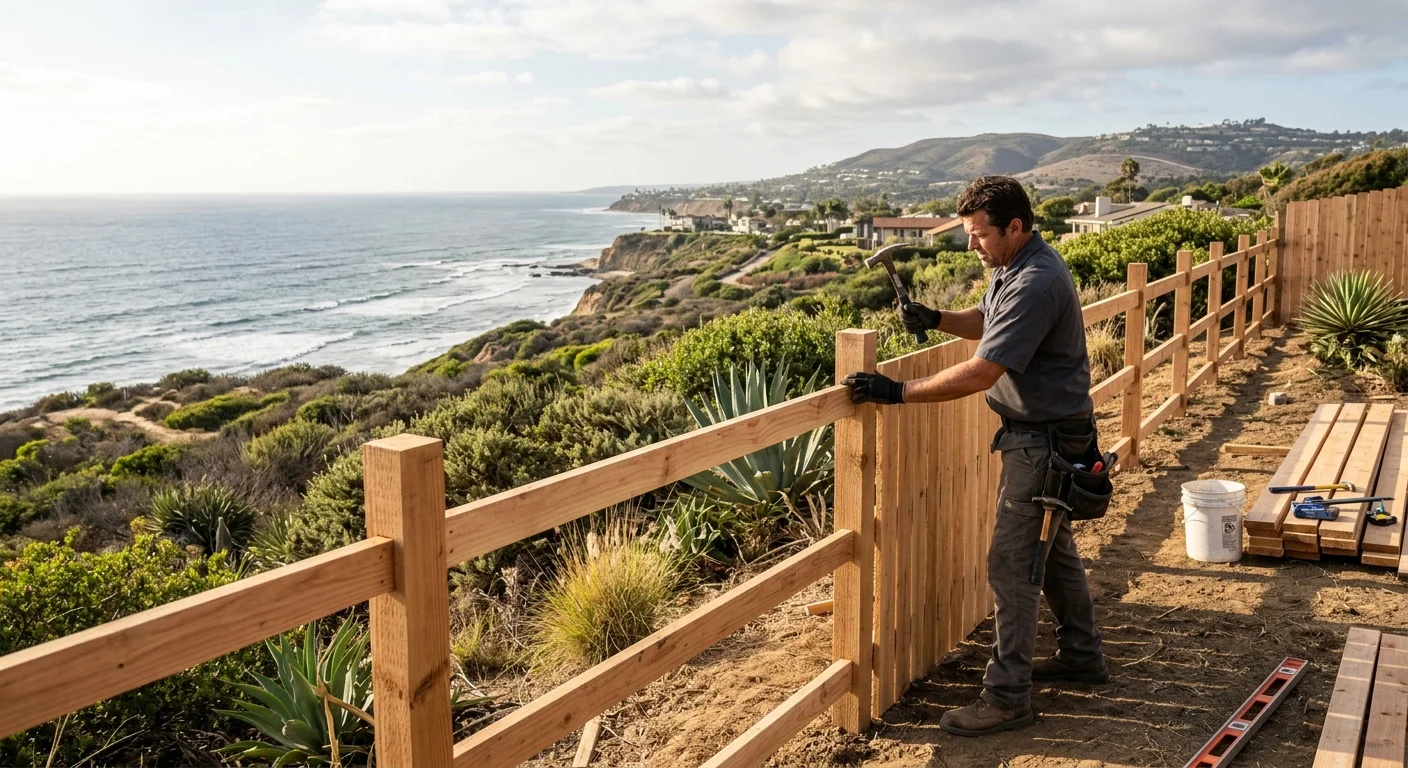
How Carlsbad lots west and east of Interstate 5 change the stain questions
Interstate 5 is the cleanest line on a Carlsbad staining walk. West of it you are in Carlsbad Village, Tamarack, the beach blocks off Carlsbad Boulevard, and the edges of Agua Hedionda and Batiquitos lagoons. Fences there sit closer to salt air, marine moisture, and irrigation from dense plantings. Boards that face the ocean or a lagoon often gray first. Bottom rails stay damp longer after night fog and morning watering. Metal hinges and fasteners rust into the wood and leave dark streaks that a new coat will not hide.
East of I-5 the pattern shifts. La Costa, Bressi Ranch, Calavera Hills, and Robertson Ranch sit farther from the surf. Lots still get coastal weather, but they take more open sun, less salt, and more HOA color control. South- and west-facing runs bake. North runs stay cooler and hold old film longer. A stain that looks even on a shaded side yard can look thin on the run that faces El Camino Real or Palomar Airport Road.
The same street name can sit on both sides of that line. A Village lot a few blocks from the water is not a Bressi Ranch lot near the industrial parks. Ask the contractor to talk about this yard, not “Carlsbad” as a climate. Note which runs face the ocean, a lagoon, a neighbor’s two-story wall, or a bare slope. Note irrigation heads that hit the fence. Note whether the gate is on the windward side.
That local read is why this page is not a copy of fence staining in Encinitas. Encinitas has its own bluff and highway pattern. Carlsbad’s lagoon pockets, Village density, and inland tracts change the inspection. If you are still choosing who to call for the larger fence picture in this city, start with our Carlsbad fence company overview, then come back to stain scope.
Wood fence staining Carlsbad jobs also split by use. A privacy run along a side yard gets more splash from planters. A front picket line in the Village gets more foot traffic and more eyes from the HOA or the city street. A rear line on an inland slope gets more sun and more soil movement at the posts. The finish has to match the exposure, the wood that is still sound, and the rules for that lot.
What a staining pro inspects on wood, hardware, and nearby soil splash
A staining pro should walk the line before anyone talks color. Start with the wood. Sound cedar or redwood that has gone silver can still take a penetrating stain after the right prep. Boards that cup, split at the fasteners, or crush under a thumbnail are repair work first. Soft spots show up at grade, at the bottom rail, and wherever a sprinkler hits the same boards every afternoon. Gray is weathering. Soft is decay. Those are different jobs.
Look at both faces. A coastal fence stain Carlsbad run often looks better on the neighbor’s side than on the street side, or the reverse, because sun and salt do not hit both faces the same way. End grain at post tops and picket cuts drinks finish. Mill glaze on newer boards sheds it. Old film that still peels will peel through a new coat. The contractor should say what has to come off, and with what method, before a product name shows up on the page.
Hardware is the second pass. Hinges, latches, decorative caps, and fasteners rust in the Village and along the lagoons faster than they do inland. Rust bleeds into the grain. Stain will not seal that stain out. Sometimes the hardware needs swapping. Sometimes it needs isolation so the new finish is not a brown halo around every screw. Gate bottoms that drag pick up grit and hold moisture. A stained gate that still drags will wear through at the strike.
Soil splash is the third pass, and it is easy to skip. Planter beds piled against the boards, dog paths, and mower throw all load the lower third with grit and moisture. Inland clay holds water against the skirt. Coastal sand and lagoon-edge soils drain differently, then the irrigation puts the water back. A mow strip or a clear gap at grade is a site condition, not a product feature. If dirt stays banked on the fence, the new finish fails there first.
Ask for that inspection in writing: which runs, which faces, which posts, which gate, and what the pro found at grade. Fence staining and sealing is the service that work falls under. The people we match you with are licensed independent fence contractors. You contract with them directly.
When prep, board replacement, and staining deserve separate quotes
A single lump line that says “stain fence” hides the real job. Prep, carpentry, and finish are three scopes. Mixing them makes two Carlsbad proposals look equal when they are not.
Prep is washing, waiting for the wood to dry, removing failed film, and opening the grain so stain can move in. A Village fence with years of old coating is a different prep day than a newer inland fence that has only grayed. Pressure, chemistry, and sanding are choices the contractor should name. Over-washing raises grain and fuzz. Under-washing leaves contaminants that print through. Dry time depends on that week’s weather and on shade from a two-story house or a lagoon-side hedge. No honest bid can promise a clock for that.
Board replacement is carpentry. Failed pickets, a rotten bottom rail, a post that moves, or a gate that sags belong on a repair line. Staining over those pieces wastes the finish. It also makes the new boards look like patches unless the contractor plans the blend. If more than a handful of boards are gone, ask whether stain still makes sense on the rest of the run, or whether a larger wood repair should come first.
Keep those as separate quote lines: prep, replacement, stain. Then you can drop or keep a line without reopening the whole number. California Business and Professions Code section 7048 exempts contractor licensing only when the aggregate contract for labor, materials, and all other items is under $1,000, the work is casual, minor, or inconsequential, and it does not need a building permit. The exemption does not apply if the work is part of a larger job, if contracts are split to stay under the threshold, if the person advertises as a contractor, or if the person hires others to do the work. A full fence stain plus prep and board swaps often sits above that line. Confirm the contractor’s license on the CSLB license check before you sign.
If the fence sits on a shared boundary, Civil Code section 841 also applies. Adjoining private landowners are presumed to share equally in reasonable costs of construction, maintenance, or necessary replacement unless a written agreement says otherwise. Before you incur those costs, you must give each adjoining owner 30 days’ written notice. The notice has to describe the problem, the proposed work, estimated costs, the cost-sharing plan, and the timeline. Staining a shared line is maintenance. Get the notice right, then get the quotes.
How to compare two Carlsbad staining proposals
Line the two packets up by scope, not by the first number on the page. Both should name the property, the runs, and whether both faces get finish. Posts, rails, caps, and gates are easy to leave out. A coastal fence stain Carlsbad bid that skips the lagoon face or the gate is not the same job as one that coats every exposed surface.
Product type matters more than a brand slogan. Transparent, semi-transparent, and solid stains behave differently on gray wood, on mill-glazed new boards, and on old film. Our guide to fence stain types in San Diego is the place to learn those classes. Do not treat a product sheet as a life span. Recoat intervals and warranties are not something this site can confirm, so ask the contractor to put the product name, sheen, and number of coats in the proposal, then confirm current terms with the manufacturer.
Application method belongs in the comparison. Brush, pad, or spray each leave a different film on pickets and on the back side of a board-on-board run. Overspray on stucco, solar panels, cars, and lagoon-side glass is a site risk west of I-5. Masking and plant protection should be written down. So should what happens if the weather turns after wash-down. A proposal that assumes a perfect weekend is not a plan.
Exclusions are the rest of the comparison. Does the price include furniture and planter moves. Does it include hardware swap. Does it include a sample board on the actual fence. Who owns color sign-off if the HOA later objects. Who hauls debris. Who protects irrigation clocks and dog runs. Two Carlsbad staining proposals that skip those lines are not comparable.
Check the license, insurance, and the name on the contract. Fence Pros San Diego is a referral service. We match you with licensed independent fence pros. We do not stain, we do not set prices, and we do not hold the trade license. The contractor you hire is the one whose CSLB record you should read.
Which finish or HOA questions need confirmation for that address
Finish color is not a citywide Carlsbad rule. It is an address rule. La Costa, Aviara, Bressi Ranch, and other planned tracts often keep architectural binders that name allowed stain families, sheens, and whether solid colors are even on the list. Those binders change, and they are not in a public ledger we can quote. Call the association, get the current finish language in writing, and put that language in the contractor’s scope. A sample on the actual fence, in the actual sun, beats a chip in a kitchen.
If you are not in an HOA, the City of Carlsbad still may care about height, placement, and work in the right-of-way. This page does not treat staining as a permitted or unpermitted act, because that call belongs to the city for that lot. Ask Planning or Building at the City of Carlsbad before you assume a wash-and-stain needs nothing. Coastal lots and lagoon-adjacent lots can sit in overlay areas that inland tracts do not. Confirm the address, do not borrow a neighbor’s answer from the other side of I-5.
Shared-fence color is a neighbor question as well as a statute question. Civil Code section 841 lets a written agreement override the equal-cost presumption. It does not pick a stain color for you. If one owner wants a transparent cedar look and the other wants a solid HOA brown, settle that in writing before anyone buys product.
Keep the questions tied to this lot: which runs, which faces, which product class, which HOA clause, which city contact, and which neighbor notice. That is how fence stain Carlsbad work stays local. The Encinitas staining notes and a countywide stain-type guide help you learn the vocabulary. They do not replace a walk of your Village alley, your lagoon-side rail, or your inland HOA tract.
When to call us
Call when the wood is still sound enough to finish, or when you already know some boards have to come out before anyone opens a can. Call when two proposals disagree on faces, prep, or hardware, and you want a licensed fence contractor to walk the I-5 split on your lot. Call us at (858) 400-4906 and we’ll connect you with a licensed fence contractor.