A Ramona pasture and a Fallbrook garden can share the same aisle and still need different wire. A woven wire fence is field fabric stretched between braced posts. Welded mesh is a fused grid that hangs on a short, even run.
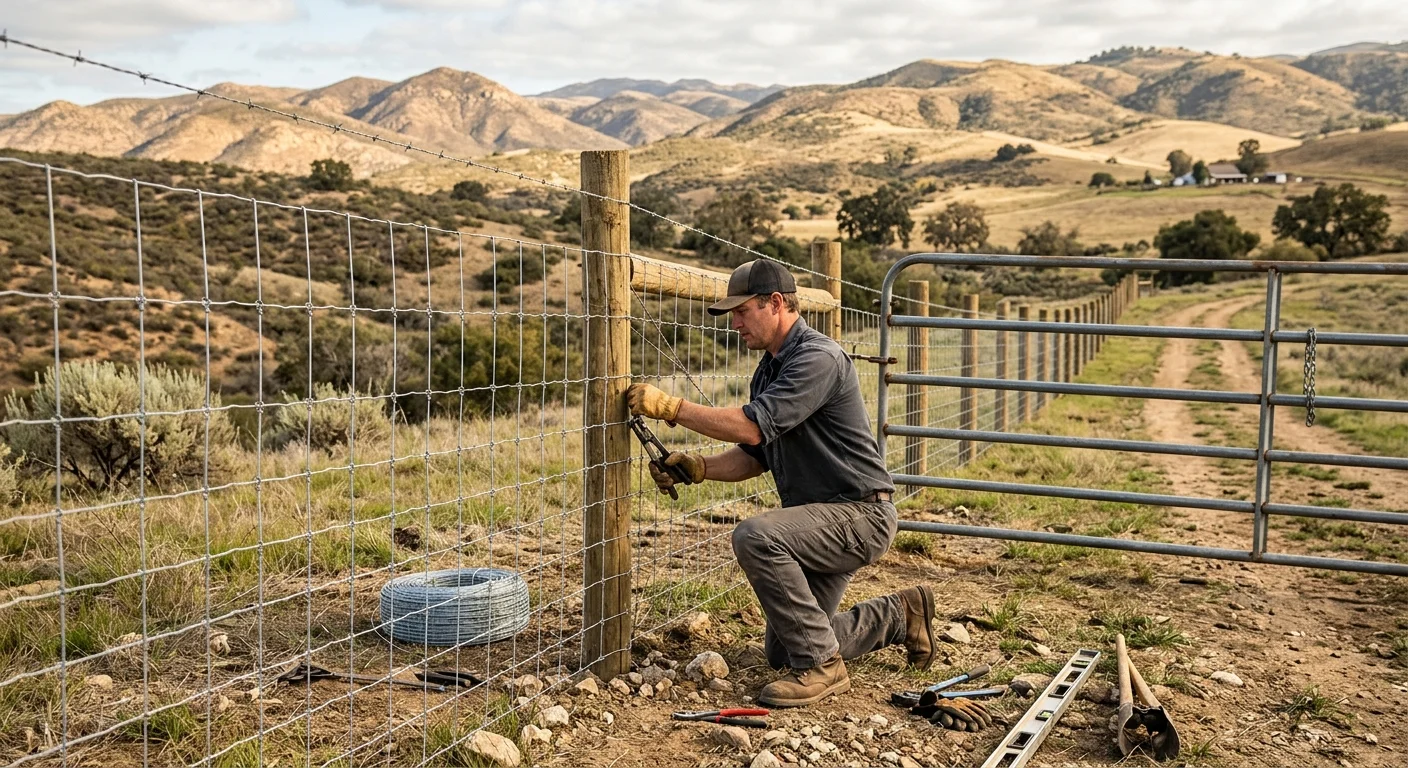
How woven field fabric differs from welded mesh on a real lot
Woven wire is horizontal line wires and vertical stays joined by a wrap or a knot at each crossing. The joint can move a little under a hit, then sit back. Welded mesh looks like the same grid with those crossings fused. It hangs flat on a short, even bay. When a weld pops, you have a hole and a sharp stub. That joint is the product difference that matters on the dirt. The lot decides which one you can live with.
On a long Ramona or Valley Center pasture, animals test the middle of a span and the ground rises and falls. Woven fabric is made to be stretched between braced ends. That stretch is the structure. Line posts keep the fabric in plane. They are not a picture frame for floppy panels. Welded wire is covered as its own page. This one is the field fence choice on a rural San Diego County lot.
Welded mesh belongs on short, fair grade: a garden, a kennel, a trash pad, a side return where posts can sit close. Kids, dogs, and irrigation sit nearer those runs. Welds dislike a big animal shove or a long sag. A failed weld is a panel patch. A poorly spec’d woven run is a belly across a whole bay.
Inland north county is dry heat, decomposed granite, and winter rain in the same post holes. Coastal salt is not the main enemy in Ramona. Fallbrook adds grove irrigation and shade that keeps wood posts wet. None of that assigns a gauge. Manufacturers print gauge and coating on the roll. A 12 gauge stamp is a product label, not a county rule, and not proof it will hold goats. Have the contractor match the printed spec to the animal and the span, then name that roll in the quote.
Treat neither mesh as a pool barrier. Pool enclosures sit under a separate California statute. Field fabric is not that product.
Where Ramona, Fallbrook, and Valley Center uses tend to split
Ramona, Fallbrook, and Valley Center sit inland, mostly in unincorporated county, on bigger acreage than a Clairemont back yard. The wire still splits by use, soil, and how water actually moves.
Ramona runs open and granite. Highland Valley, San Vicente Road, and the flats toward the Santa Maria Valley take long pasture fences and horse paddocks. Fabric has to climb small ridges and drop into swales without leaving a crawl space at the bottom. Woven field fence is the usual conversation for those long runs. Welded mesh shows up on the garden, the dog yard, and the short screen by the house. Santa Ana winds shove those open lines. A specific fence wind-load figure could not be confirmed against a government source for this page. The contractor still has to design braces for that exposure, and you still confirm height with the county.
Fallbrook is hill, grove, and nursery more than open grass. Mission Road, De Luz, and Live Oak country mix avocado irrigation with steep cuts. A wire line under trees fights roots, drip leaks, and shade. Short welded runs around a garden or a pump pad are common. Long woven runs still belong on the outer pasture. A specific agricultural mesh height or livestock spacing could not be confirmed against County of San Diego sources. Confirm those with Planning & Development Services before you order a roll.
Valley Center sits between those two. Horse properties along Valley Center Road and Lilac Road need a horse-property fence conversation, not a garden-panel one. Board or pipe on the show side, woven fabric on the contain side, welded mesh where a stall, tack yard, or kitchen garden needs a tight grid. Coyotes and wandering dogs show up on all three maps. Ground gap, gate latch, and fabric choice work together.
Walk the use first: pasture, paddock, grove edge, garden, kennel, or street perimeter. Then pick woven or welded. Then pick posts. The farm fence overview is the wider rural menu. This comparison is only the wire.
What posts, braces, gates, and grade details belong in writing
A woven wire fence installation lives or dies at the ends. Fabric under tension pulls corner posts inward. A single unbraced post is not a corner. The quote should name terminal posts, the brace style the contractor will actually build, and which bays get extra bracing. Gate posts are terminals too. A field gate breaks the tension. It needs braced posts on the hinge side and the latch side, written down.
Line posts are a different sentence. They hold the fabric up and in line. They do not replace the brace. Ask for post material, post spacing, and how the fabric is fastened: staples on wood, clips on steel, and which face of the post the wire sits on.
Which face matters. On a livestock run, many installers put the fabric on the animal side of the line posts. A shove then loads the posts instead of peeling the fasteners. On a garden keep-out line, the shove can come from raccoons, dogs, or people on the outside. Put “wire on the animal side” or “wire on the outside face” in the paperwork so the crew and the neighbor see the same drawing.
Grade is the other silent failure. Inland lots step. They do not sit level. Woven fabric can follow a fair slope if the contractor racks it and keeps the bottom wire close to the dirt. Sharp cuts need a step, a buried apron, or a different panel. Leave a triangular gap at a swale and kids, dogs, and goats will find it. The quote should say how the bottom is treated: follow grade, step, or add a kick or rail.
Stretch method belongs in writing for woven fabric. Stretcher bars, come-alongs, and a stop at each terminal are labor, not a footnote. Welded mesh is usually hung, not stretched like field fabric. If a bid mixes the two products on one line, split the line. Linear feet without braces, gates, and grade notes is not a fence installation scope.
When garden, livestock, and perimeter runs deserve separate quotes
One roll rarely serves three jobs. A kitchen garden off a Fallbrook casita wants a tight grid and frequent posts. A goat or sheep paddock wants fabric that does not open when a horn or a hoof works a joint. A street-side perimeter wants height, setback, and neighbor notice that have nothing to do with a tomato cage.
Goat work is the search people actually run. Goats climb, squeeze, and chew. A county goat-fence height or mesh size could not be confirmed against primary sources for this page. Skip buying a catalog sheep-and-goat roll and calling the lot done. Have the licensed contractor walk the animals, the slope, and the existing wire. Then specify fabric type, height, ground gap, brace plan, and gates as their own quote. Mix goats with horses on one fence and you will under-build one of them.
Garden and kennel runs can stay on welded mesh when the spans stay short and the grade stays fair. The moment that same fence becomes the outer property line, you’re in a different permit and neighbor conversation. Split the bid: garden bay, livestock bay, perimeter bay. Shared corners still need one brace plan so the two products do not fight at the splice.
Perimeter along a neighbor is Civil Code §841 territory when it is a boundary fence. Adjoining landowners are presumed to share equal benefit and reasonable cost unless a written agreement says otherwise. Thirty days’ written notice has to describe the problem, the proposed work, estimated cost, cost-sharing, and timeline. Government land is outside that statute. Confirm who owns the line before anyone stretches wire.
If the job is over the contractor-license threshold, it is not a casual weekend roll-out. California Business and Professions Code §7048 sets that aggregate threshold at $1,000 for labor, materials, and all other items, and it blocks splitting work to dodge the number. Check the person you hire on the CSLB license lookup. A C-13 fencing contractor is the classification that covers constructing, erecting, altering, or repairing fences, corrals, runs, railings, gates, and similar work, excluding masonry walls.
Which property questions need official confirmation
Start with jurisdiction. Ramona, Fallbrook, and Valley Center are unincorporated communities. County of San Diego Planning & Development Services is the office that speaks for those addresses. City of San Diego Development Services does not. If the parcel is actually inside a city (Escondido, San Marcos, Oceanside, and others sit next door), that city’s rules control.
For unincorporated lots, the county’s publicly posted PDS070 sheet, revised January 1, 2023, lists a permit exemption for fences and walls no higher than 6 feet when the fence is zoning compliant. The same sheet’s zoning summary lists 42 inches at the front and exterior side, and 72 inches at the rear and interior side. Confirm that sheet still applies to your parcel before anyone orders fabric. Zoning, easements, and special districts can still block a no-permit job.
Inside the City of San Diego, Municipal Code Chapter 14, Article 2, Division 3, Table 142-03A lists fences below 7 feet as no permit under that division, and 7 feet or greater as a Building Permit / Process One. Required side and rear yards may allow up to 9 feet with the portion above 6 feet open. A solid fence at the front or street-side line is generally 3 feet, with setback-based provisions and coastal overlay caveats. An exemption under that table is still separate from zoning compliance. Call the city on the address.
A required agricultural overlay height, a livestock containment mesh, and a required wire gauge could not be confirmed against a primary source for this page. A hardware-store label is a product spec. Ask PDS, or the city that governs the address, for the current rule. Ask the contractor for the product sheet.
Survey the line if the run is a boundary. Stretching woven fabric a foot onto the neighbor is an expensive knot to undo. Put the APN, the jurisdiction, the height, the product, the brace plan, and the gate schedule in one written scope.
When to call us
Long field runs, mixed garden and livestock lines, and any fence that needs tensioned fabric plus braced corners are C-13 work. Fence Pros San Diego is a referral service that matches you with licensed, independent fence contractors you contract with directly. Call us at (858) 400-4906 and we’ll connect you with a licensed fence contractor.