A wood privacy fence that used to hide the neighbor’s patio can start showing slivers of light between the boards. In San Diego County that pattern is rarely random. The way those privacy fence gaps between boards open, and where they open, tells you whether the boards, the rails, or the posts are the real problem.
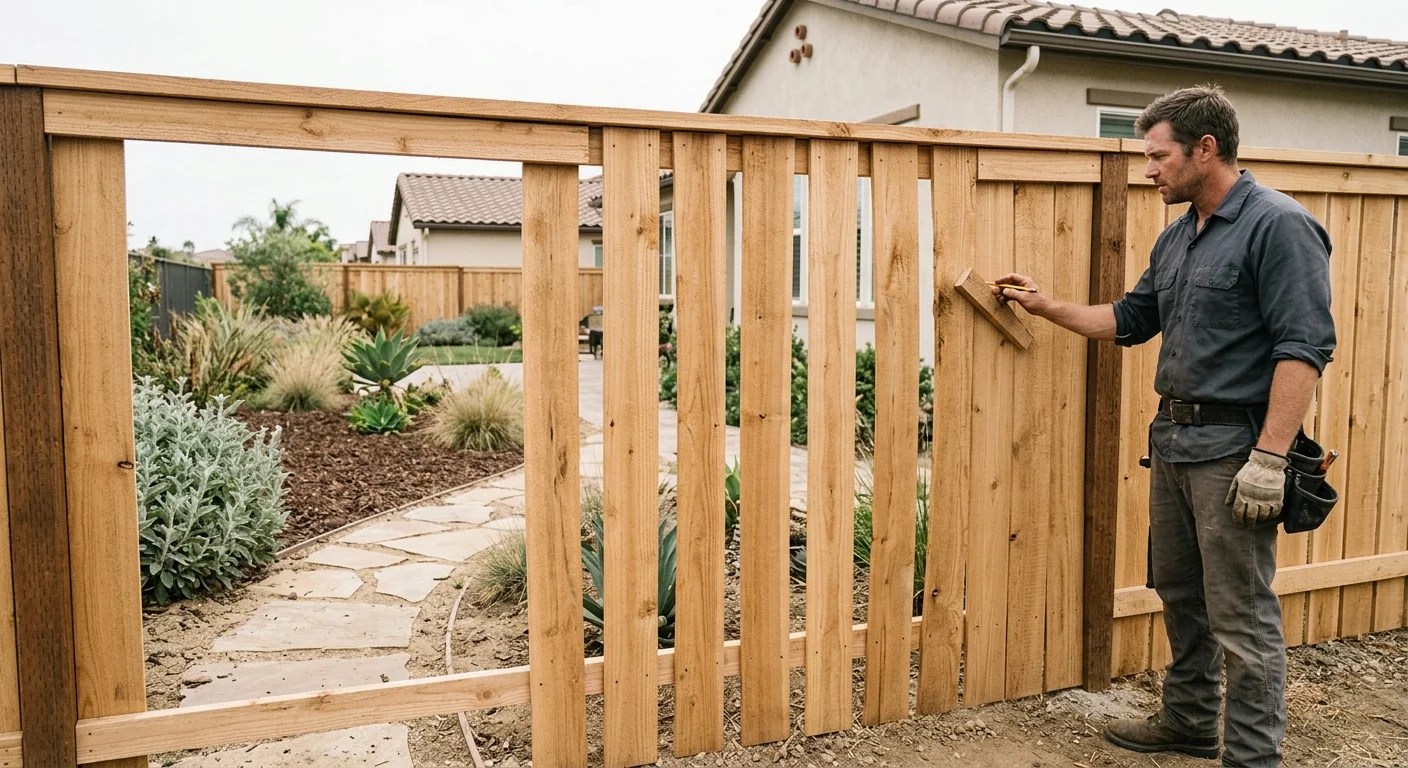
What changing gaps can reveal about boards, rails, and posts
Privacy fence gaps between boards look the same from a patio chair. They aren’t. A licensed fence contractor reads the pattern before anyone talks about replacing lumber.
When only a few boards have opened, and the rest of the panel still sits true, the wood itself is the first suspect. Boards take on water and give it back. They shrink as they dry. They cup toward the wetter face. A board that dried faster than its neighbors can pull away at the edges and leave a vertical slot you can see through. Fasteners that have backed out let that board drift even more.
A different pattern shows up when the rails have moved. Gaps that widen in a wave, or that open more at mid-height than at the post, often track a rail that has twisted, pulled a fastener, or dropped at a joint. The boards may still be sound. They’re hanging on a line that is no longer straight. Standing at the end of the run and sighting along the rails is more useful than staring at one gap.
The third pattern is structural. If gaps open in a fan, wider at the top or along a whole bay, the post may be out of plumb. Soil movement, irrigation at the footing, or a post that has started to rot at grade can rack the panel. Swapping the open boards on a leaning post just recreates the same sightline later.
There’s no county ordinance that sets a typical gap between privacy boards. Style does that work. A tight, board-to-board privacy face is meant to limit sightlines. A board-on-board fence covers those sightlines with an overlap even after the wood moves. Whether you’re supposed to leave a gap depends on the style the installer built, not on a single recommended number.
Filling gaps with strips, lattice, or screen without reading that pattern can hide a failing rail or post. The fill may also trap moisture against the boards. Treat it as a diagnosis problem first, a privacy patch second.
How coastal and inland exposure change the inspection questions
San Diego County is not one climate. A fence on a Coronado, Imperial Beach, or Encinitas lot lives in salt air and a marine layer that can sit on the wood for hours. Boards stay damp longer. Hardware corrodes faster. Gaps that open after a dry Santa Ana stretch can close again once the fog returns. On the coast, the inspection question is whether the movement is seasonal wood change, or whether salt and moisture have already weakened fasteners and rails.
A few miles inland the story flips. El Cajon, Santee, Escondido, and Ramona see hotter afternoons and drier air. Wood can give up moisture quickly in late summer. Gaps that appear after a stretch of heat are common on inland privacy fences, especially on west and south faces that take afternoon sun. Inland, the inspection question is whether the boards have simply dried, or whether heat has also split the ends, loosened nails, and left the rails checking.
May Gray and June Gloom keep Encinitas and Carlsbad fences damp in late spring, while El Cajon can already be running hot and dry. Mid-county yards sit in between. City Heights, Mission Valley, and Kearny Mesa can get coastal moisture in the morning and inland heat by afternoon. Look at which side of the fence faces the weather. The street side and the yard side often age differently. South Bay lots in Chula Vista and National City pick up bay moisture, then inland heat as you move away from the water.
Irrigation matters in every climate zone here. Spray heads that soak the lower third of a privacy fence swell those boards while the tops stay dry. That uneven moisture is a classic way wood fence gaps open in a scallop along the bottom. So is a slope that sheds water toward one post line in East County clay, or a sandy coastal strip that never holds water at the footing.
Santa Ana winds add a second read. Dry offshore wind pulls moisture out of wood across the county. It also loads a solid privacy face like a sail. If gaps opened after a wind event and the posts now lean, the issue is no longer board shrinkage.
Why a fence pro should inspect the full affected section
One open joint is easy to stare at. The useful unit is the bay between two posts, plus the bays on either side. A C-13 fencing contractor is the California classification for people who construct, alter, or repair fences. That’s the trade you want walking the line.
The contractor should check both faces. Privacy boards are often fastened from one side. The neighbor’s side can show pulled fasteners, a rail pulling off a post, or rot you can’t see from the yard. They should check the post at grade, the rails at each connection, and whether the gap is uniform from top to bottom. Uniform slots that opened along many boards after a dry stretch point one way. A single widening crack beside a post points another.
If the fence is also the pool enclosure, the gap question changes. California Health and Safety Code section 115923 sets enclosure rules for the private pools and spas it covers. Those rules include a ban on openings that a 4-inch sphere can pass through, along with other height, gate, and climb limits in that same section. That statute is not a blanket rule for every backyard privacy fence. It is a reason to have a licensed pro look at any opening on a fence that is doing pool-barrier duty.
Shared property-line fences add process. California Civil Code section 841 presumes adjoining landowners share equally in the reasonable costs of a dividing fence unless a written agreement says otherwise. Before you incur those costs, the statute requires 30 days’ written notice that describes the problem, the proposed work, the estimated costs, the sharing plan, and the timeline. A pro’s inspection notes and photos make that notice clearer. They don’t replace it.
Before you hire, confirm the contractor’s license on the CSLB license check. Fence Pros San Diego is a referral service. We match you with licensed, independent local fence professionals. You contract and pay the contractor directly.
When boards, panels, and longer runs deserve separate quotes
Gaps that live in a handful of boards can be a board-level repair. Gaps that follow a twisted rail are a panel problem. Gaps that track a leaning post line are a run problem. Those are different scopes, and they should be quoted as such.
Ask the contractor to separate the work in writing. Board replacement on a sound frame is one item. Rail or hardware work is another. Post repair or replacement is a third. If several bays have opened and the remaining boards are thinning, checking, or pulling through fasteners, the conversation may shift from fence repair to the repair-versus-replacement call for that stretch.
A longer run of privacy fence that has lost its screen on one elevation may still be fine on the other. Don’t assume the whole backyard needs the same treatment. A north-facing bay in shade can hold moisture while the west-facing bay has dried and opened. Quotes that lump those together hide the real work.
Board-on-board or a screen add-on can close sightlines without pretending the structure is new. That’s a design choice after the frame is proven true. If the posts are out, covering the gaps only delays the next lean. Repair gaps in a wood fence only after that inspection, not as a strip nailed over a leaning bay.
Rates move with lumber, access, and scope, so this page doesn’t publish a market figure. The contractor’s quote should describe what is being replaced, what is being left, and why. If the job is small, California Business and Professions Code section 7048 exempts work from contractor licensing when the aggregate contract price for labor, materials, and all other items is less than $1,000, the work is casual, minor, or inconsequential, and it doesn’t need a building permit. Advertising as a contractor, splitting jobs to stay under that number, or hiring others to do the work takes the exemption away. For fence work that is more than a minor patch, you want a licensed C-13 contractor on the contract.
What photos help document the gap pattern
Good photos save a second visit and help a neighbor see the issue if this is a shared fence. Shoot in even daylight, not hard noon glare that hides the slots.
Start with the full affected section, posts included, from far enough back that any lean is visible. Then take a tight shot of the gap at mid-board and another at the fastener line. If the opening is wider at the top, capture that. If it’s only at the bottom, capture the soil and any irrigation overspray.
Stand at the end of the run and photograph down the rail line. That end view is how a pro sees racking. Photograph both sides of the fence. Include the post base, any concrete, and any soil or mulch piled against the wood.
A second set after the sprinklers run, or after a dry, windy day, can show whether the gaps move. Label the photos with the street side, the house side, and the nearest landmark. If you send them in, include the city and whether the lot is near the coast, in a canyon, or inland. That context changes the inspection questions.
Don’t treat a product photo of gap filler as a diagnosis. Strips, screens, and extra pickets have their place after the frame is sound. They’re a poor first move when the pattern points at a post.
When to call us
Call when the gaps keep changing, when you can see through to a neighboring yard, or when the panel no longer sits true. A licensed fence contractor should inspect the full section before anyone fills or replaces boards. Call us at (858) 400-4906 and we’ll connect you with a licensed fence contractor.