Installing a privacy fence starts with a proposal that defines the line, materials, access, and approval assumptions. It should turn a backyard conversation into a written scope you can check before choosing a contractor.
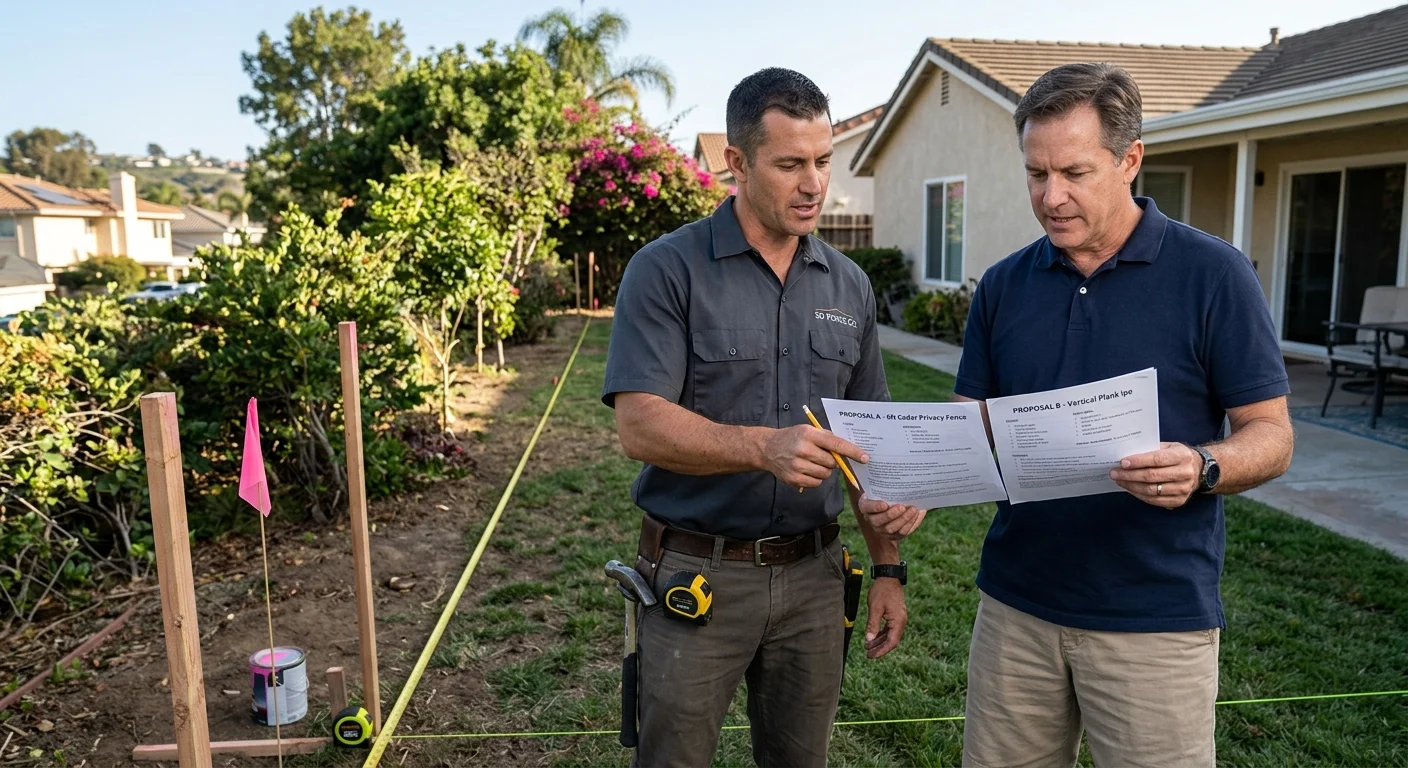
A useful proposal lets you understand what the contractor plans to build. It also makes competing offers easier to compare. Before accepting one, confirm that every important choice appears in writing.
How the proposed fence line and access plan should be documented
Start with the exact area covered by the proposal. A simple labeled sketch can show the fence line, corners, returns, gates, and connections to existing structures. It should distinguish new sections from fencing that will remain.
The written scope should also identify the measured length used for the proposal. If two contractors measured different lines, their totals won’t describe the same project. Ask each contractor to explain where the difference begins and ends.
A visible fence isn’t proof of a legal property boundary. The proposal should identify the information used to place the planned line. That might be markings supplied by the homeowner or another property document. It shouldn’t imply that the fence contractor has determined the legal boundary.
Access deserves its own notes. The contractor should document the route proposed for workers, materials, and removed fencing. Side yards, stairs, gates, planting areas, and narrow passages should appear when they affect the plan. The proposal should also say who moves outdoor furniture, planters, decorations, or other obstacles.
Ask what happens to the existing fence. Removal, hauling, and disposal shouldn’t be left to assumption. The same applies to disturbed landscaping, irrigation near the line, and surfaces along the access route. The document should separate included work from homeowner responsibilities.
Jurisdiction should be named too. “San Diego” may describe the region without identifying the authority for that parcel. Ask the contractor to name the applicable city, or San Diego County for an unincorporated address.
A detailed site plan gives you a clearer starting point for privacy fence installation. It also helps prevent a proposal for one layout from being compared with a different layout.
Which material, post, gate, and finish details belong in writing
A material name alone doesn’t define a privacy fence. “Wood fence” or “vinyl fence” leaves many choices unresolved. The proposal should name the proposed material, style, profile, color, and visible configuration.
For a wood design, ask for the board orientation, overlap or spacing, rails, trim, and cap details. For a manufactured system, ask for the product line and component names. These details let both bidders describe the same finished appearance.
Posts need more than a passing reference. Each proposal should state the proposed post material, dimensions, spacing, setting method, and footing approach. You’re not choosing a specification from a generic checklist. You’re asking each contractor to document the system proposed for your property.
Site-specific details matter across San Diego County. For a coastal address in Encinitas or Imperial Beach, ask the contractor to identify the hardware proposed for that location. For an inland property in El Cajon or Escondido, ask for written notes about the grade and ground conditions observed during the visit. Don’t accept broad labels without product or installation details.
Every gate should appear separately. Record its location, opening width, swing direction, frame, hinges, latch, stops, and connection points. A drawing can prevent confusion when a gate sits near a driveway, walkway, wall, or property corner.
Finish details also belong in the scope. If the design includes paint, stain, or another finish, the proposal should name the product, color, preparation, surfaces covered, and application plan. If finishing isn’t included, that exclusion should be direct.
Mixed projects deserve extra care. The CSLB’s C-13 fencing classification covers fences and gates but excludes masonry walls. A proposal combining a fence with masonry should identify who handles each portion. The broader fence installation service page explains how we connect homeowners with independent local pros.
How property lines, HOA review, and permits should be confirmed
Property-line, HOA, and permit questions should be resolved before the proposal becomes the working installation plan. The contractor can document the proposed line, but shouldn’t present that sketch as a legal boundary determination.
If the boundary is uncertain or disputed, pause the project. Gather the available property documents and seek qualified property guidance before approving the line. Our guide to San Diego property-line fence rules explains the issues to review without treating a contractor’s field sketch as boundary proof.
Shared fences need careful communication. California Civil Code Section 841 says adjoining landowners are presumed to share equal benefit and reasonable costs unless they agree otherwise in writing. It also requires 30 days’ advance written notice before a landowner incurs costs for a shared fence. The notice must describe the problem, proposed solution, estimated costs, proposed cost sharing, and proposed timeline.
That statute doesn’t settle every property situation. Ask for legal guidance if ownership, responsibility, or notice obligations remain unclear. Keep neighbor discussions separate from the contractor’s responsibility to describe the proposed work.
No countywide HOA approval rule could be confirmed from the approved claims ledger. Your association’s current documents and written instructions control its review process. Check the recorded restrictions, architectural guidelines, and required submission materials. Get the association’s decision in writing before authorizing work. Our San Diego HOA fence approval guide offers a practical review checklist.
City of San Diego Table 142-03A uses 7 feet for that division’s building-permit split. Section 142.0310 still limits front, street-side, visibility, and open-face design. Unincorporated County PDS 070 excepts qualifying fences not over 6 feet that also meet zoning. Other incorporated cities have their own desks. Do not paste a 6-foot or 7-foot rule onto a city this job did not capture. Contact the named city or County authority for the parcel. Permits by city.
The proposal should state who will ask the authority, who will submit any required materials, and what happens if the approved plan changes. It should not claim that approval is unnecessary without confirmation from that desk.
What to compare when two contractor proposals differ
Begin by checking whether both contractors priced the same fence. A lower total may reflect a shorter line, fewer gates, different posts, unfinished surfaces, or excluded removal. Compare the written scope behind each total before comparing the totals themselves.
Create one side-by-side checklist with these items:
- Fence line, measured length, corners, and returns
- Material, style, profile, color, and visible layout
- Post material, dimensions, spacing, and setting method
- Gate locations, widths, frames, hinges, and latches
- Finish products, preparation, and covered surfaces
- Existing-fence removal, hauling, and disposal
- Access route and homeowner preparation
- Property-line and approval assumptions
- Included work, exclusions, and requested alternatives
Blank spaces matter. If one proposal names every post and gate detail while another says only “privacy fence,” ask the second contractor to revise the document. A verbal explanation won’t help if the written scope still describes something different.
Look for conflicting assumptions. One contractor may expect the homeowner to clear the line. Another may include removal in the proposed work. One may base the layout on owner markings, while another may assume the current fence follows the intended line. Those differences need written resolution.
Don’t ask a contractor to copy another bidder’s construction plan blindly. Ask both to explain their choices for the same site. Then request revised proposals built around one agreed fence line and one clear list of desired features.
Confirm the identity of the contractor named in each proposal. You can check current license information through the California Contractors State License Board. Fence Pros San Diego is a referral service. We match homeowners with licensed, independent fence contractors. We do not perform the work, set proposal terms, or issue the contractor’s warranty.
A strong privacy fence installation proposal makes differences visible. You should be able to identify what will be built, where it will sit, what’s excluded, and which questions remain open before signing.
When to call us
Installing a privacy fence calls for a licensed fence pro when the project involves licensed construction work or needs a contractor’s site-specific proposal. Call us at (858) 400-4906 and we’ll connect you with a licensed fence contractor.