A coyote-resistant fence in San Diego needs to be at least 6 feet tall with no footholds, plus one of two upgrades: a rolling top bar (a coyote roller) or a top section angled outward at 45 degrees, since coyotes climb rather than jump. The base matters just as much. Bury wire mesh 12 to 18 inches deep, or angle a footer outward 18 to 24 inches, because coyotes dig under a fence they can’t get over.
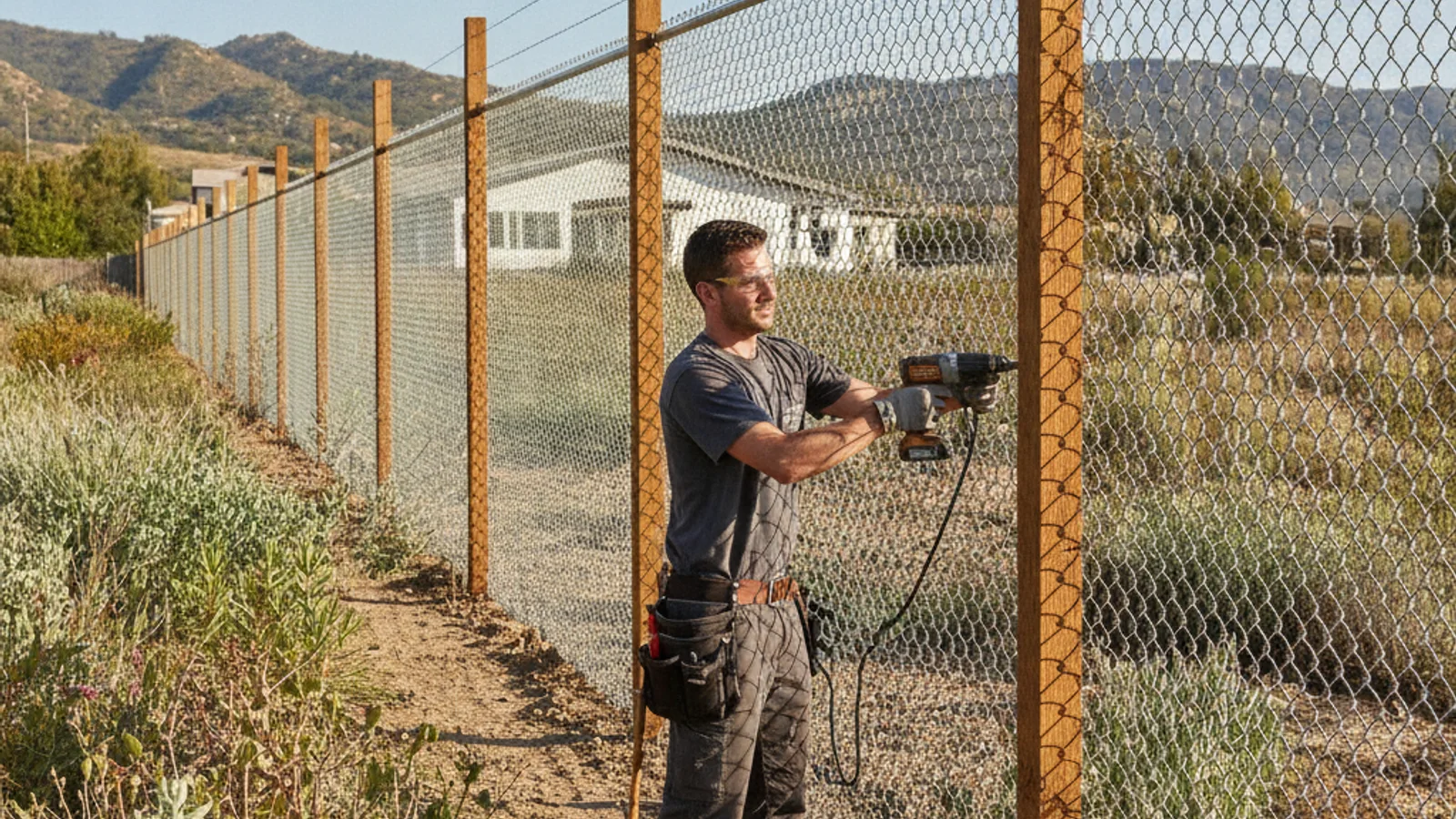
San Diego County has one of the densest urban coyote populations in Southern California, and it’s not limited to rural backcountry. Canyons cut through the middle of dense residential neighborhoods here, which puts coyotes within a few hundred feet of backyards in Scripps Ranch, Tierrasanta, Poway, and Rancho Bernardo just as much as in Ramona or Alpine. A standard 6-foot privacy fence stops a lot of problems. It does not stop a coyote on its own, because coyotes are strong climbers and diggers, not just jumpers. This guide covers the specific upgrades that close that gap, what they cost, and where in San Diego they matter most.
How tall a coyote fence actually needs to be
Six feet is the baseline, not the finish line. Most coyotes can scale a plain 6-foot fence in seconds if it gives them any foothold, whether that’s chain-link mesh, horizontal rails, or a rough wood surface. The height requirement itself isn’t the hard part. San Diego’s standard 6-foot residential fence height limit (no permit needed in most jurisdictions) already clears the minimum most wildlife agencies recommend.
The part builders skip is denying the climb. A solid vinyl or wood privacy panel with no horizontal rails on the outside face is already harder to scale than chain-link or a rail-and-picket style fence, because there’s nothing for a paw to grip. That’s one reason we point coyote-conscious clients toward the same privacy fence styles we’d recommend for a pool enclosure or a backyard with small pets. If your existing fence has horizontal support rails on the outside, that’s effectively a ladder, and it’s worth flagging in any fence height conversation with your installer.
Coyote rollers and dig-guards: the two upgrades that matter
A rolling top bar, sometimes called a coyote roller, is a length of PVC pipe, metal tubing, or a purpose-built rolling bracket mounted along the very top of the fence. When a coyote gets a paw over the top edge and tries to pull itself up, the bar spins under its weight instead of holding still, so there’s nothing to grip. It’s the single most effective retrofit for an existing fence, and it doesn’t require rebuilding anything below the top rail. Expect to add roughly $8 to $15 per linear foot to install rollers along an existing fence line, depending on material and whether the top rail needs reinforcing first.
The other half of the problem is underground. Coyotes dig, and a determined one will excavate under a fence post faster than most homeowners expect, especially in the loose decomposed granite common across inland San Diego County. Two fixes work: bury galvanized wire mesh 12 to 18 inches straight down along the fence line (an L-footer bent outward works even better in sandy or loose soil), or angle the bottom foot of fencing outward at the base so a digging coyote hits mesh instead of open ground. Either approach runs about $5 to $10 per linear foot on top of the base fence cost. Skipping it is the most common reason an otherwise-solid fence still gets breached.
One more detail that gets missed: gaps. Gate clearances, drainage gaps at the bottom, and gaps where fence sections meet a house or another structure should stay under 4 inches. Coyotes are lean and flexible enough to squeeze through openings that look too small to matter.
Coyote fence upgrades at a glance
| Upgrade | What it stops | Added cost |
|---|---|---|
| 6-ft solid privacy panel (no footholds) | Baseline climb resistance | Included in a standard privacy fence install |
| Coyote roller on top rail | Climbing over the top edge | $8-$15 per linear foot |
| Buried wire apron or angled L-footer | Digging under the fence | $5-$10 per linear foot |
| Gaps kept under 4 inches | Squeezing through gates and seams | Design detail, no added material cost |
| Chain-link alone, no roller | Nothing. Easiest style for a coyote to climb | N/A |
Which San Diego neighborhoods need this most
Canyon-adjacent and open-space-adjacent lots carry the most coyote pressure in the county. Scripps Ranch, Tierrasanta, and Poway back directly onto Mission Trails Regional Park and connected canyon systems. Rancho Bernardo, Rancho Santa Fe, and the 4S Ranch area sit against open space and undeveloped ravines that funnel wildlife right up to backyard fences. Further out, Ramona, Alpine, and the rest of East County have the least development buffer of all, so coyote traffic through a yard is closer to routine than exceptional.
None of this means coastal or urban-core properties are exempt. Coyotes have been documented moving through canyon fingers in La Jolla, Encinitas, and even dense neighborhoods well inside the city limits. If your property backs onto any greenbelt, canyon, golf course, or drainage channel, the upgrades above are worth the added cost regardless of which part of the county you’re in. If small dogs or cats use the yard unsupervised, pair these upgrades with the containment details in our dog fence guide, since a coyote-resistant perimeter and a pet-secure perimeter solve two different halves of the same problem.
Frequently asked questions
How tall does a fence need to be to keep coyotes out?
Six feet is the minimum most wildlife professionals recommend, and it matches San Diego’s standard no-permit residential fence height. Height alone isn’t enough. A 6-foot fence without a roller or angled top and without a buried or angled base is still climbable and diggable, so the height number only works when it’s paired with those upgrades.
Can coyotes climb a 6-foot fence?
Yes, easily, if the fence gives them any foothold. Chain-link, horizontal rail fencing, and rough wood surfaces are all climbable for a coyote in a few seconds. A solid vinyl or wood privacy panel with no exterior rails is harder to scale, and adding a rolling top bar stops the climb even on fence styles that would otherwise be easy.
Do coyotes really dig under fences?
Yes, and it’s one of the most common ways a fence gets breached even when the height and top are handled correctly. San Diego’s loose, sandy, and decomposed-granite soils in many inland areas make digging easier than it would be in denser clay soil. Burying wire mesh 12 to 18 inches or angling the base outward 18 to 24 inches closes that gap.
What is a coyote roller and does it actually work?
A coyote roller is a rotating bar, usually PVC pipe or a purpose-built metal roller bracket, mounted along the top of a fence. When a coyote grabs the top edge to pull itself over, the bar spins instead of holding still, so there’s nothing solid to climb on. It’s a well-documented, low-cost retrofit that doesn’t require replacing the fence itself, just the top rail treatment.
Is a chain-link fence enough to keep coyotes out?
Not on its own. Chain-link is one of the easiest fence styles for a coyote to climb, since the mesh itself provides a foothold at every gap. A roller retrofit on top of an existing chain-link fence closes most of that gap without a full rebuild, but a solid privacy panel is the stronger baseline if you’re building new.
How much does it cost to coyote-proof a fence in San Diego?
Retrofitting an existing fence with a roller and a buried or angled base typically adds $13 to $25 per linear foot on top of what’s already there. Building new, a 6-foot solid privacy fence already runs $40 to $95 per linear foot installed depending on material (see our privacy fence cost breakdown), with the coyote-specific upgrades layered on top of that base price.
When to call us
Coyote-proofing isn’t a standalone fence style, it’s a set of upgrades layered onto a fence you already have or one you’re about to build. Fence Pros San Diego installs rollers, buried wire aprons, and angled dig-guards on existing fences, and builds new privacy fencing with those upgrades included from the start for canyon-adjacent and open-space-adjacent properties across the county. Call us at (858) 400-4906 for a same-day estimate.