Rusted chain link fence repair starts with finding where the metal has weakened. Localized corrosion may support a focused repair. Widespread damage across fabric, rails, posts, or gates deserves replacement quotes for comparison.
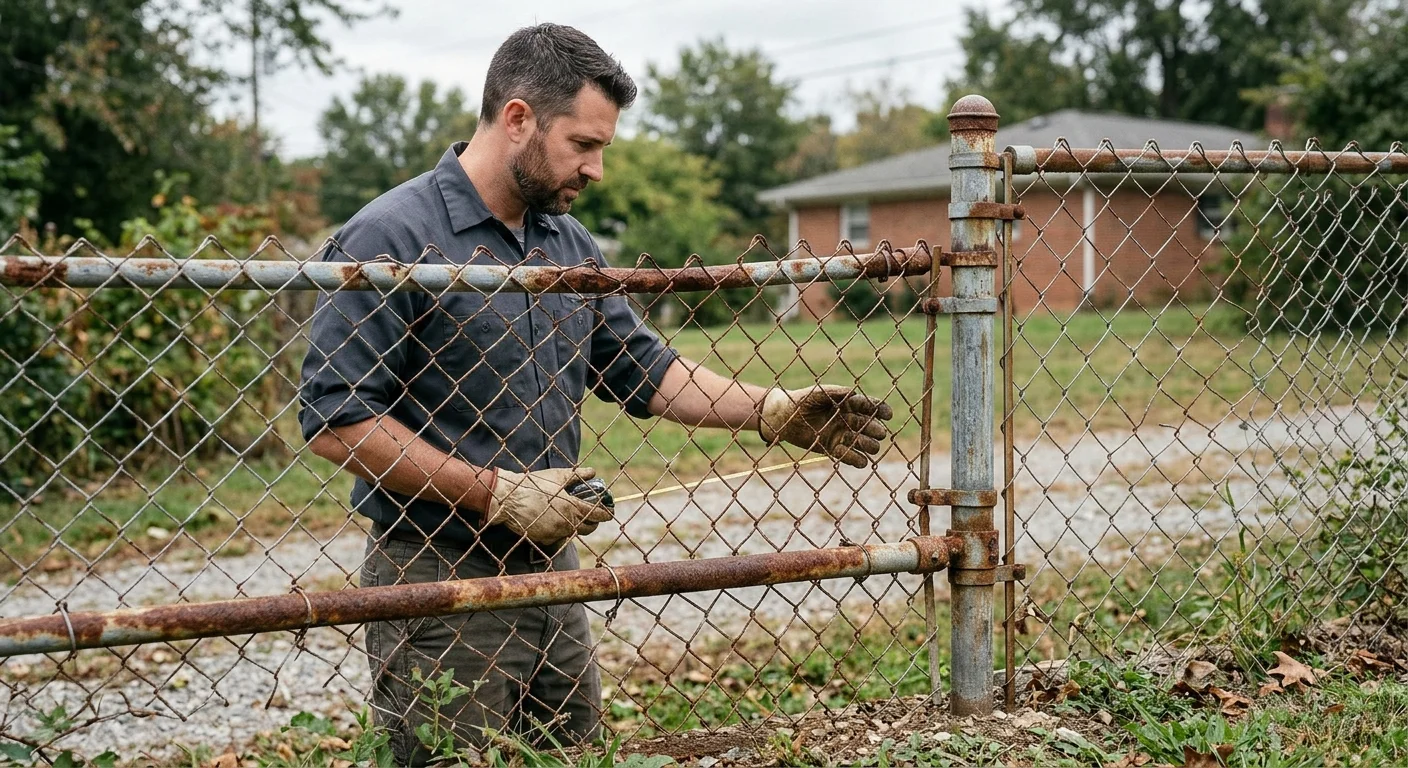
The decision shouldn’t come from color alone. A contractor needs to inspect the affected parts, their connections, and the fence around them.
How visible corrosion can affect different fence components
A rusty chain link fence isn’t one continuous piece. It’s a group of connected components. The fabric, line posts, terminal posts, rails, tension hardware, ties, and gate parts can deteriorate differently.
Start by noticing where the visible corrosion appears. Rust limited to a small fitting presents a different question than corrosion across several fabric panels. Staining near the ground also deserves closer review because the nearby post, wire, or rail may need inspection.
The pattern matters as much as the color. A contractor may look for flaking surfaces, expanding holes, broken wires, open seams, or distorted fittings. They’ll also note whether the affected component still connects firmly to the surrounding fence.
Location gives that inspection useful context. A fence beside a coastal lot in Imperial Beach isn’t evaluated from photos alone. Neither is one beside an irrigated slope in Escondido. Tell the contractor where the fence sits and what surrounds it.
The original finish also matters. Galvanized and coated components shouldn’t be treated as interchangeable without checking their condition. Our guide to galvanized chain link fencing in San Diego explains that finish in more detail.
Visible rust doesn’t automatically answer the repair-or-replace question. It identifies the areas that deserve a closer component-level assessment. The condition beneath and around those areas guides the next step.
What pros inspect on fabric, posts, rails, and fittings
A fence professional usually separates the inspection by component. That keeps one rusty part from being mistaken for failure across the entire fence.
On the fabric, the contractor may check for broken strands, holes, loose edges, and damaged connections. They’ll compare the corroded area with nearby fabric that appears intact. They may also check whether the mesh still holds its intended shape and tension.
Posts need a different review. A pro can examine the visible post surface, the area near grade, and the post’s stability. Movement, openings in the metal, or a poor connection with the rails can change the proposed scope. Paint or another coating can hide parts of that condition, so photos aren’t always enough.
Rails and braces help connect the fence system. The contractor may inspect joints, couplings, bends, and spots where water or debris collects. A rail with surface discoloration presents a different repair decision from one with missing metal or a damaged connection.
Small fittings deserve attention too. Bands, bolts, caps, ties, tension bars, and hinge hardware can affect how adjacent pieces stay connected. Replacing an isolated fitting may be considered when the surrounding metal remains suitable. Several deteriorated connections may point toward broader work.
A fence repair contractor can document which pieces need attention. Ask for the proposed scope by component. That makes it easier to understand whether the quote covers fabric, posts, rails, hardware, or a complete section.
How gates and terminal posts change the repair decision
A gate opening isn’t just another stretch of chain link fabric. It includes moving hardware, a frame, a latch, hinges, and supporting posts. Corrosion in that area can affect alignment as well as appearance.
A contractor may operate the gate while checking its condition. They’ll watch how it swings, closes, and meets the latch. They may also look for rust around welds, corners, hinge points, and frame connections. A gate that drags or won’t latch needs an alignment review alongside the corrosion inspection.
Gate posts and terminal posts deserve separate attention. These posts sit at openings, ends, and changes in the fence line. The pro may check whether they remain stable and whether attached hardware still sits correctly. Replacing fabric alone won’t address a weakened post or damaged gate connection.
Photograph the gate in both open and closed positions. Include the hinges, latch, frame corners, and the base of each supporting post. If the gate has changed position over time, mention that when requesting an assessment.
Our guide to chain link gates in San Diego covers gate configurations and common planning details. For a rusted gate, the practical question is narrower: which gate and support components remain serviceable, and which should be quoted for replacement?
When coating, part replacement, or a new section deserves a quote
Coating, replacing individual parts, and rebuilding a section solve different conditions. A contractor should identify the affected metal before recommending one of those scopes.
A coating deserves discussion when the concern appears limited to the surface and the component remains suitable for continued use. The contractor still needs to evaluate the preparation and coating options. Covering visible rust without assessing the metal won’t reveal whether deeper damage exists.
Part replacement may make sense when corrosion is concentrated in removable pieces. Examples could include ties, bands, caps, tension hardware, or an isolated rail. The surrounding posts and fabric still need inspection because new hardware depends on sound connection points.
A new section deserves a quote when several connected parts show deterioration. That scope might include fabric, rails, fittings, or supporting posts within the affected run. Ask the contractor to define where the replacement starts and ends. The proposal should also identify any components intended to remain.
A whole-fence replacement comparison may be useful when corrosion appears across multiple sections. It may also help when gate and support problems overlap with fabric damage. That doesn’t mean full replacement is automatically required. It gives you another scope to compare with targeted repair.
If replacement becomes the better fit, review the available chain link fence installation options with the matched contractor. The final decision should reflect the inspected condition, site needs, and separate contractor quotes. Fence Pros San Diego doesn’t set contractor prices or warranties.
What photos help a contractor assess the condition
Clear photos help a contractor understand the request before visiting. They don’t replace an inspection, but they can show which components need attention.
Start with a wide view of the full fence line. Include corners, ends, elevation changes, and nearby gates. Then take closer images of every visibly corroded area. Keep enough surrounding fence in each frame to show where that area sits.
Useful photo subjects include:
- Both sides of the corroded fabric
- The bases and tops of nearby posts
- Rail joints, couplings, and braces
- Bands, bolts, ties, caps, and tension hardware
- Gate hinges, latches, corners, and support posts
- Holes, broken wire, bent metal, or loose connections
- A nearby section that appears intact for comparison
Don’t scrape, strike, or heavily pull corroded metal just to improve a photo. Photograph what’s visible and describe any movement you already noticed. Keep people and pets away from sharp or detached wire.
Add the city, neighborhood, and fence location when sending the images. San Diego County includes coastal north county, inland north county, the central city, East County, and the South Bay. Site context helps the contractor avoid treating every property as identical.
Mention whether the affected run includes a property boundary, pool area, gate opening, retaining condition, or public-facing edge. If replacement changes height or turns an open mesh into a screened solid face, ask the named city or County desk. City Table 142-03A uses 7 feet for that division’s building-permit split. Unincorporated PDS 070 excepts qualifying fences not over 6 feet that meet zoning. Other cities: that city’s counter. Permits by city. California’s C-13 classification covers chain link fences and gates and excludes masonry walls.
When to call us
Call when corrosion reaches posts, rails, gates, broken fabric, or several connected parts. Those conditions need an assessment from a licensed fence professional.
Call us at (858) 400-4906 and we’ll connect you with a licensed fence contractor.