A fence leaning beside a tree raises two questions: what moved, and why? Tree roots damaging fence components may seem like the obvious answer. Still, one visible root isn’t enough to confirm the cause.
Document the changes first. Then let an arborist and licensed fence contractor assess their separate areas. Don’t cut roots, excavate footings, or force the fence upright beforehand.
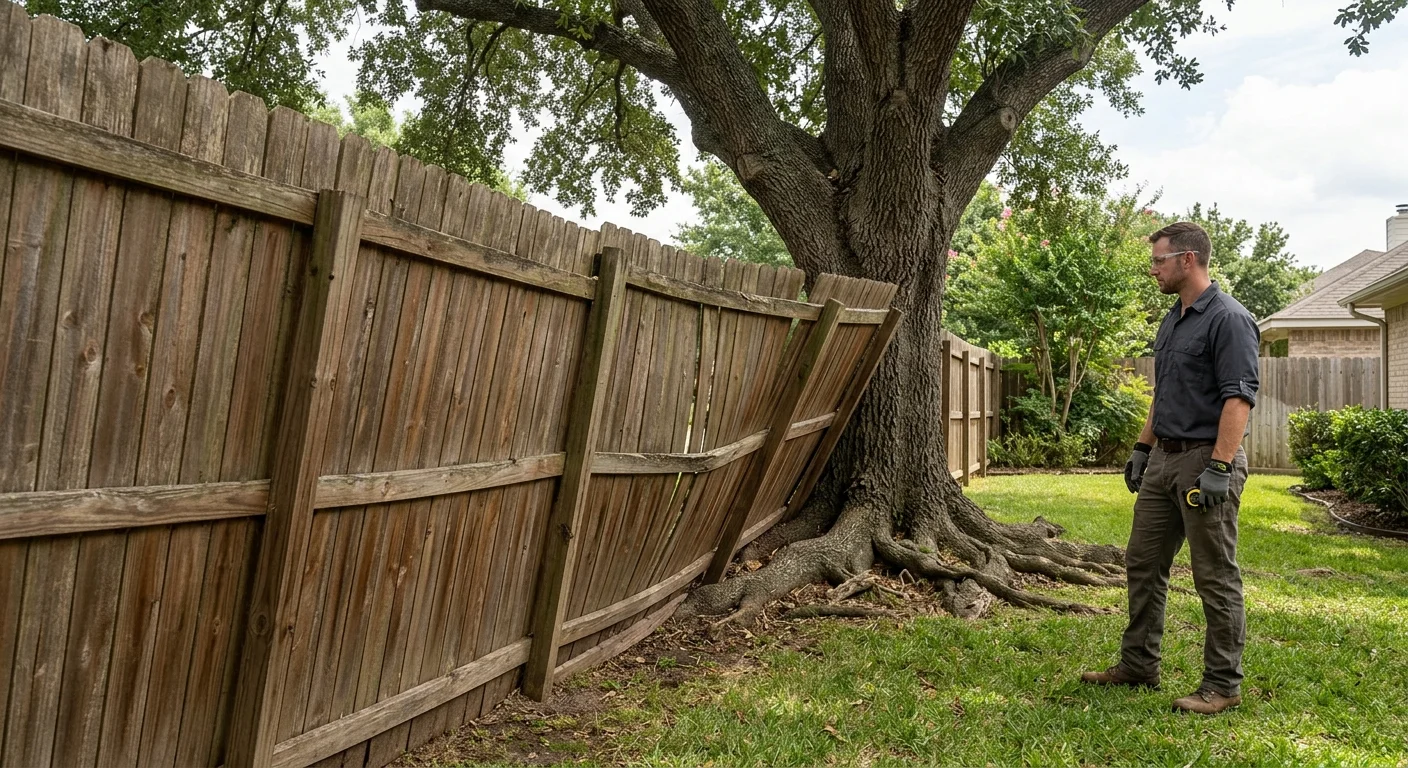
What leaning posts, lifted footings, and cracked rails can indicate
Start by viewing the whole fence line from both ends. A single leaning post presents a different repair question than several misaligned sections. Note where the shift begins, where it ends, and how close visible roots are.
A leaning post tells you that its position has changed. It doesn’t prove that a root moved it. Record whether the post leans alone or pulls neighboring rails and panels with it. Check the adjoining gate without forcing it. A changed gap or latch position gives the contractor another comparison point.
A lifted footing may appear higher on one side. You might also see a gap between the surrounding ground and the footing. Photograph the complete base before taking closer images. Don’t remove soil, exposed material, or nearby roots to improve the view.
Cracked rails and separated panels help trace the visible movement. Record whether the crack meets a post, crosses a fastener, or sits farther along the span. Include nearby panels, even when they look unchanged. That wider view helps a fence professional understand how far the misalignment extends.
San Diego County properties vary in layout. A narrow side yard in Chula Vista creates different access questions than a hillside edge near La Mesa. An Oceanside yard may also have a different jurisdiction than an El Cajon property. Record the address and exact jurisdiction with your notes. That information will matter if the proposed work changes the fence line.
Why the tree and fence need separate assessments
The tree and fence require different professional judgments. An arborist can assess the tree, visible roots, and possible effects of proposed work. A fence contractor can assess posts, footings, rails, panels, gates, and fence alignment.
Keep those assignments separate. Don’t ask a fence contractor to prescribe root cutting. Don’t ask an arborist to select a footing design or price fence repairs. Instead, let each professional document findings within their field.
Timing matters because one proposed solution can affect the other assessment. If visible roots occupy the area around a shifted post, arrange the arborist’s review before approving excavation. Share that assessment with the fence contractor. The contractor can then prepare options that account for the tree professional’s recommendations.
The fence assessment should cover more than the nearest post. Ask the contractor to inspect adjoining spans and any connected gate. A post movement may appear in rail joints, panel spacing, or gate alignment. The scope should identify what stays, what changes, and what remains uncertain.
We couldn’t confirm one current fence or tree rule covering every San Diego County jurisdiction. For a City of San Diego address, contact Development Services. Table 142-03A still uses 7 feet for that division’s building-permit split, and 142.0310 still caps front-yard solid height. In another city, ask that city. For unincorporated land, County PDS 070 excepts qualifying fences not over 6 feet that meet zoning. Confirm before approving a rerouted fence or a changed height.
How an arborist and fence pro divide the decisions
The arborist should address questions about the tree. Show the arborist the post location, exposed roots, footing, and direction of movement. Ask for written notes that the fence contractor can review. Those notes should distinguish observed conditions from anything that still requires investigation.
The fence professional should address the fence assembly. That includes the shifted post, its footing, connected rails, panels, fasteners, and gates. If movement reaches several spans, ask the contractor to show where the proposed repair begins and ends.
California’s C-13 fencing classification covers constructing, erecting, altering, and repairing fences, posts, gates, and related barriers. It excludes masonry walls. You can review that scope and check a contractor’s license through the CSLB.
That exclusion deserves attention when a fence connects to a masonry wall. Ask the fence contractor to identify which parts fall within the fencing scope. Don’t assume one proposal covers both the fence and wall.
A useful handoff is simple. The arborist provides tree-related findings and recommendations. The fence contractor uses those findings while developing repair or replacement options. If either professional lacks needed information, pause the selection until that gap is resolved.
Fence Pros San Diego is a referral service. We match property owners with licensed, independent local fence contractors. The customer chooses, contracts with, and pays the professional directly.
When rerouting, repair, or replacement each deserves a quote
Request separate scopes when more than one path appears workable. A combined proposal can hide important differences between rerouting, localized repair, and broader replacement. Each option should state what will remain and what will be removed.
A rerouting quote makes sense when the arborist’s findings leave the existing post location unresolved. Ask the fence contractor to draw the proposed line and mark gate changes, corners, and connections. Confirm the property boundary and current local requirements before accepting that layout.
A repair quote should identify each component included. It might cover a post, footing, rail, panel, or gate adjustment. Our fence post repair service can connect you with a licensed contractor who evaluates that scope. You can also review the questions in our guide to repairing fence post footings in San Diego.
A replacement quote deserves consideration when the visible shift extends across several connected sections. Ask whether sound sections can remain. The contractor should distinguish selective replacement from replacing the entire run. Our broader fence repair service covers referrals for damaged rails, panels, posts, and related fence components.
Don’t choose solely from a photo or one total price. Compare the proposed route, included components, exclusions, and how the arborist’s findings were handled. Fence Pros San Diego doesn’t set contractor prices or warranties.
A leaning fence may have several possible repair scopes. Our guide to leaning fence repairs explains how to document the affected run before discussing those options.
What photos and measurements help before site visits
Begin with wide photos from each end of the fence. Include the tree, shifted section, neighboring spans, and nearby gate. Take another image from the property side that shows the relationship between the post and visible roots.
Next, capture closer views without disturbing anything. Photograph the complete post base before focusing on a crack or gap. Include one image showing the footing and root together. Keep tools out of the area, and don’t clear soil for a better angle.
Simple measurements create useful reference points. Record the distance between the visible root edge and the post or footing. Measure the gate gap at the top and bottom. Note the length of visible cracks and the spacing between affected posts. State where each measurement began and ended.
Avoid treating those numbers as a diagnosis. Their purpose is comparison. A contractor can use them to prepare for the site visit. An arborist can see which roots and fence components occupy the same area.
Add a short written timeline. Note when you first noticed the lean, lifted footing, cracked rail, or changed gate gap. If you have an older property photo, keep it with the new images. Don’t guess when the movement began if you don’t know.
Label each photo with its location. “North side of post near gate” is more useful than “damaged area.” Include the property address, city, and whether the fence appears to sit on a shared boundary. Tell both professionals when that boundary hasn’t been confirmed.
Send the same photo set to the arborist and fence contractor. That shared record keeps the handoff focused. It also makes unanswered questions easier to identify before anyone proposes cutting, digging, repair, rerouting, or replacement.
When to call us
Call when a shifted post, lifted footing, cracked rail, or misaligned gate needs assessment by a licensed fence professional. Arrange an arborist’s review separately when roots or the tree remain part of the decision.
Call us at (858) 400-4906 and we’ll connect you with a licensed fence contractor.