A fence topper is an add-on section mounted above an existing fence to increase privacy, height, or both. Lattice panels, spaced vertical slats, and louvered boards are the most common types. In San Diego, zoning height and the building-permit trigger are different questions. A solid 6-foot backyard fence plus a topper is often an open-above-6-feet conversation in the City, and it may also be a 7-foot building-permit question under Table 142-03A.
That’s the short answer. Here’s what each topper type actually looks like, when posts decide the job, and which desk to ask. Fence Pros San Diego is a referral service. It does not set prices or pull permits.
What is a fence topper?
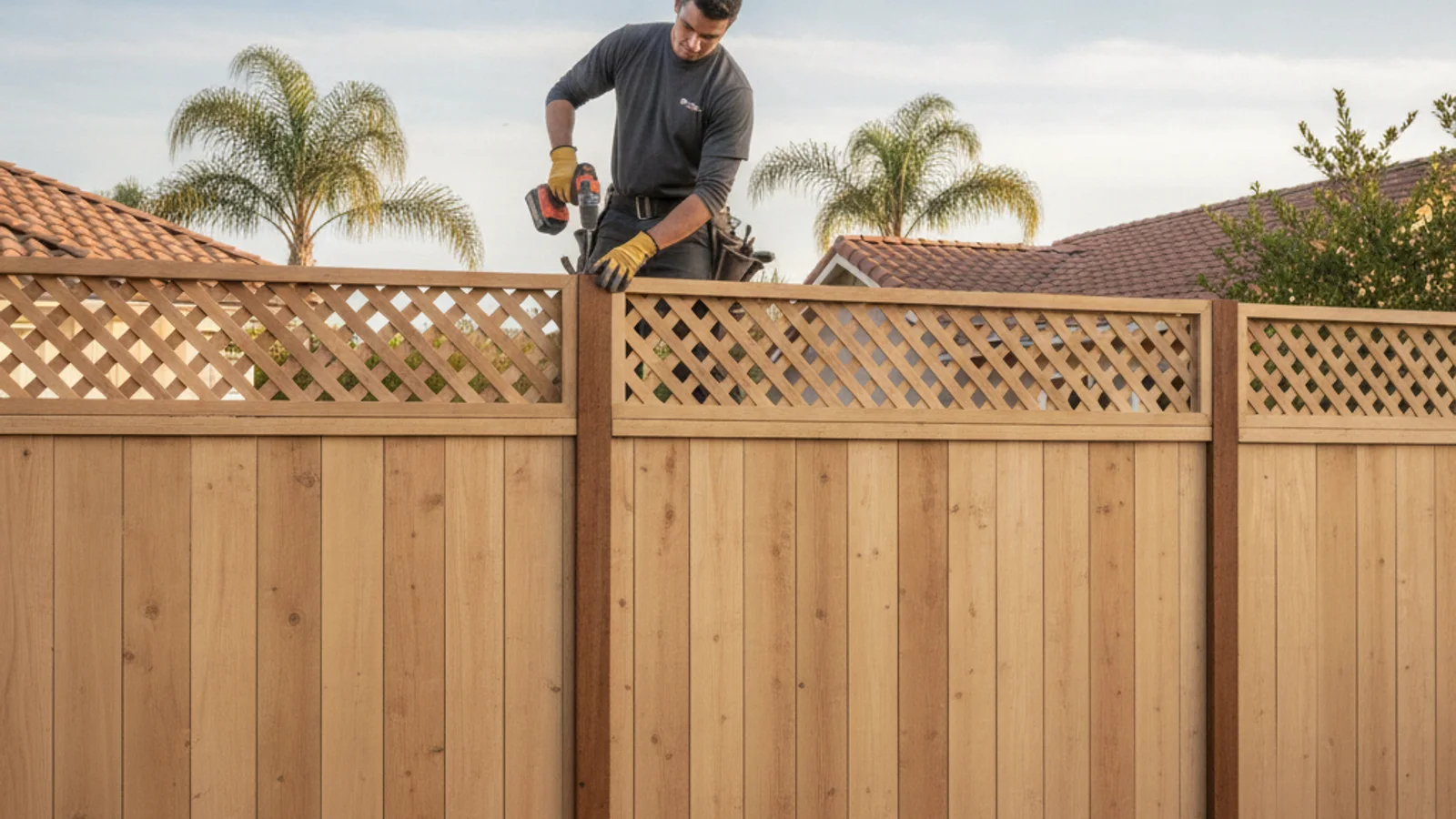
A fence topper is a separate panel or framed section that mounts directly on top of an existing fence, extending its height without removing the original structure.
Four styles show up most in San Diego:
Lattice panels. Diagonal or square grid made from wood, vinyl, or metal. Often sold in sheets and cut to match fence width. Provides partial screening and filters afternoon sun without a fully solid face.
Spaced vertical slats. Individual boards with visible gaps, framed between posts. Adds height and a sense of enclosure while remaining an open design if the gaps are real.
Louvered panels. Angled horizontal blades, similar to shutters. They can block sightlines from specific angles, especially from a raised deck or second-story window, while still allowing airflow.
Framed panel extensions. A full panel section that bolts to existing posts. This only works if the posts are tall enough and sound enough. If they aren’t, the installer may need sister posts beside the originals, which is a different scope.
How much height can a fence topper add in San Diego?
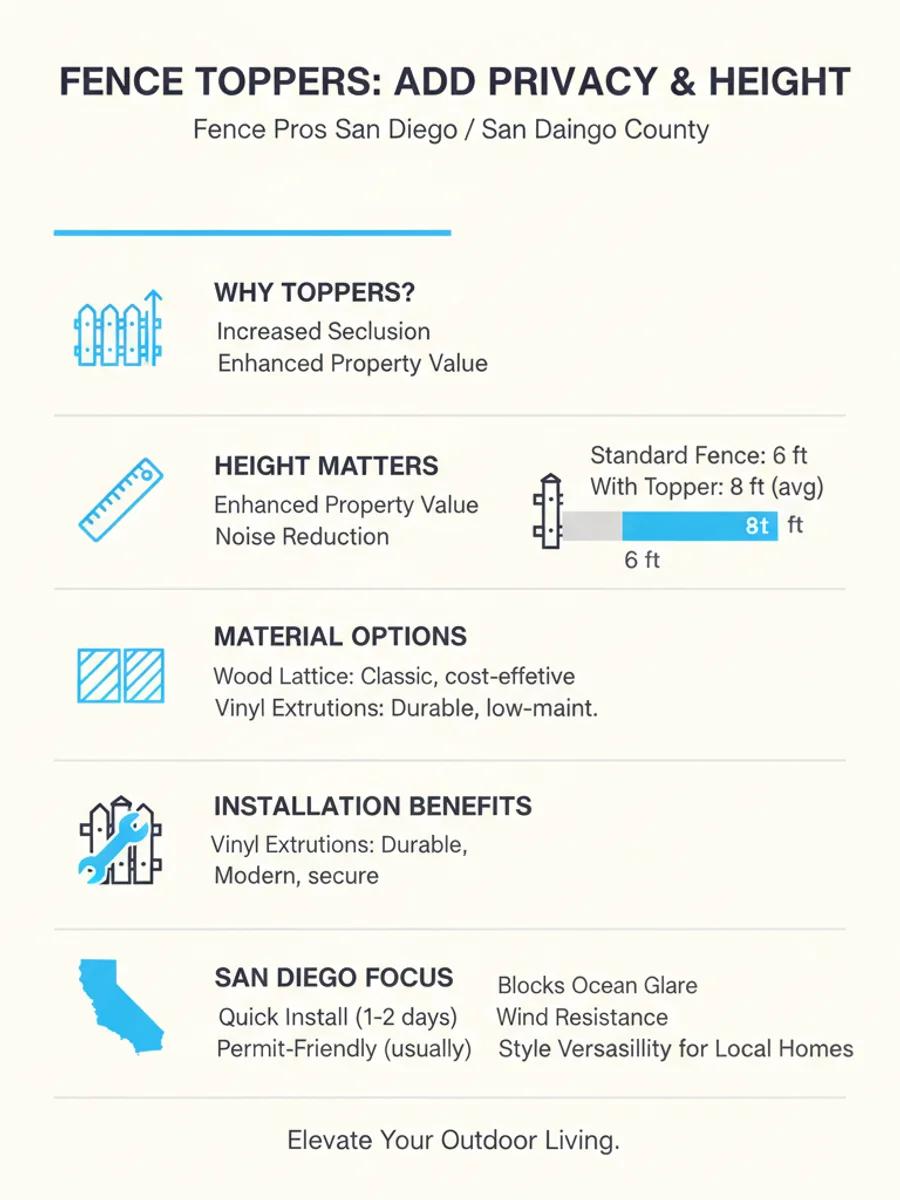
Most toppers add about 1 to 2 feet of panel. That is a product choice, not a legal ceiling.
In the City of San Diego, Municipal Code 142.0310 is the zoning height rule. Required side and rear yards may go up to 9 feet if the portion above 6 feet is open. A solid board or a tightly overlapping shadowbox that reads as solid is not that open portion. Lattice, spaced slats, and louvers are the usual candidates, but the desk still has to agree the design is open.
Building permit is separate. Table 142-03A requires a building permit for a fence 7 feet or greater. A 6-foot solid fence plus a 1-foot topper is 7 feet. That can be both a zoning question (open above 6 feet) and a permit question (7 feet).
Unincorporated County PDS 070 requires a building permit except qualifying fences and freestanding masonry walls not exceeding 6 feet that also meet zoning. Zoning excerpt: 42 inches in a front or exterior side yard, 72 inches in a rear or interior side yard. An 8-foot topper stack on a County rear line is not a backyard default.
Other cities have their own counters. Do not copy the City’s 6-foot open-above rule onto Oceanside, Encinitas, or Chula Vista without that city’s text. Fence height and fence permits spell out the City and County documents this site has on file.
Best fence topper styles for privacy
True visual privacy above 6 feet is limited if the extra height has to stay open. No legal open topper will fully block a neighbor’s second-story window. What you can do is reduce casual views.
Lattice: Filters views rather than blocking them. Grid spacing decides how much you still see. Useful for a patio glance. Weak against a second-story window.
Spaced slats: Tighter gaps hide more from a straight-on look. Angled views still leak light. Ask the contractor to show a sample gap, not a percentage.
Louvers: Can be nearly opaque from one viewing angle while remaining open to air. They also let wind pass instead of turning the topper into a sail. Santa Ana events still load the posts. Sound posts come first.
Solid panels: Legal only where zoning still allows a solid face at that total height. If you currently have a 5-foot fence, a solid 1-foot extension that stays at 6 feet in a City side or rear yard is a different project than stacking solid boards above 6 feet.
For a full new privacy run, see best privacy fence.
How much do fence toppers cost in San Diego?
A verified current per-foot price for toppers isn’t in the approved claims ledger. Fence Pros San Diego doesn’t set contractor prices. Ask for itemized proposals that separate:
- Topper material and opacity
- Fasteners and post brackets
- Sister posts or post replacement, if needed
- Removal and haul-away
- Permit applications, if the contractor includes them
Compare those lines, not a single total labeled “topper.”
Can you add a topper to any existing fence?
Not always. The existing posts decide.
A 6-foot wood privacy fence often has posts that stick above the top board. That extra height is what a bracketed topper bolts to. If the posts are rotted, cracked, or set too shallow, added sail area loads a weak base. A fence repair look at the posts is the first question, not the last.
Vinyl systems are a different problem. Many vinyl posts are hollow and sized only for the original panels. A topper may need internal blocking or sister posts. Ask the installer to say which.
If a wood fence is already leaning or soft at the bases, a wood fence rebuild to the new height can be the cleaner scope. Do not assume a topper is cheaper. Compare two written options.
Do you need a permit for a fence topper in San Diego?
Not from a single “above 6 feet” countywide rule.
- City of San Diego: zoning height in 142.0310 (open above 6 feet in required side and rear yards). Building permit at 7 feet and up (Table 142-03A).
- Unincorporated County: PDS 070 6-foot exception plus 72-inch rear/interior zoning unless an exception applies.
- Other cities: confirm with that city.
- HOA: a separate written approval, often stricter than the city.
Applying for a fence permit is the homeowner’s or the contractor’s job only if the contract says so. Fence Pros San Diego does not pull permits. HOA fence approval is a separate track. Permit by city lists other counters.
Insurance coverage of an unpermitted addition is a carrier question, not a claim this page can make.
Frequently asked questions
Can I add lattice on top of a 6-foot fence in San Diego?
In the City, an open lattice above 6 feet in a required side or rear yard is the usual zoning path, and 7 feet total is also a Table 142-03A building-permit question. County and other cities differ. Confirm the address.
How much privacy does a lattice topper actually give?
Enough to break a casual glance, not enough to hide a hot tub from a second-story window. Ask to see a sample panel from the neighbor’s likely viewing angle.
Are fence toppers cheaper than a new taller fence?
Only if the posts and footings can carry the extra height. Compare a topper quote against a rebuild quote for the same run. When a topper isn’t worth it, a privacy fence installation is the cleaner path.
Will a topper make my fence less stable in Santa Ana winds?
Any added height increases wind load. Louvers pass more air than a flat lattice sheet. Neither saves a rotten post. See Santa Ana wind fence preparedness.
Do fence toppers need their own permit?
The permit is usually for the finished fence height and design, not a separate “topper permit.” City 7-foot trigger and County 6-foot exception still apply. Check the desk that owns the parcel.
Can I add a fence topper to a vinyl fence?
Sometimes, with blocking or sister posts. Ask the installer to evaluate the existing vinyl posts before you order panels.
When to call us
If you want to add height or privacy to an existing fence, start with post condition and the jurisdiction. Call us at (858) 400-4906 and we’ll connect you with a licensed fence contractor. You contract with and pay that professional directly.