The five most common fence types for San Diego properties are wood, vinyl, chain link, aluminum or steel, and composite, and the right pick depends on three things: your privacy needs, your maintenance tolerance, and your budget. Wood starts around $20 to $35 per linear foot installed and gives you the most natural look, while vinyl runs $25 to $45 per linear foot but never needs staining. Composite costs the most upfront but routinely lasts 25 to 30 years with almost no upkeep. If you’re near the coast, vinyl or aluminum wins because salt air eats through untreated wood faster than most homeowners expect. Here’s a plain breakdown of each option so you can match the right material to your specific property.

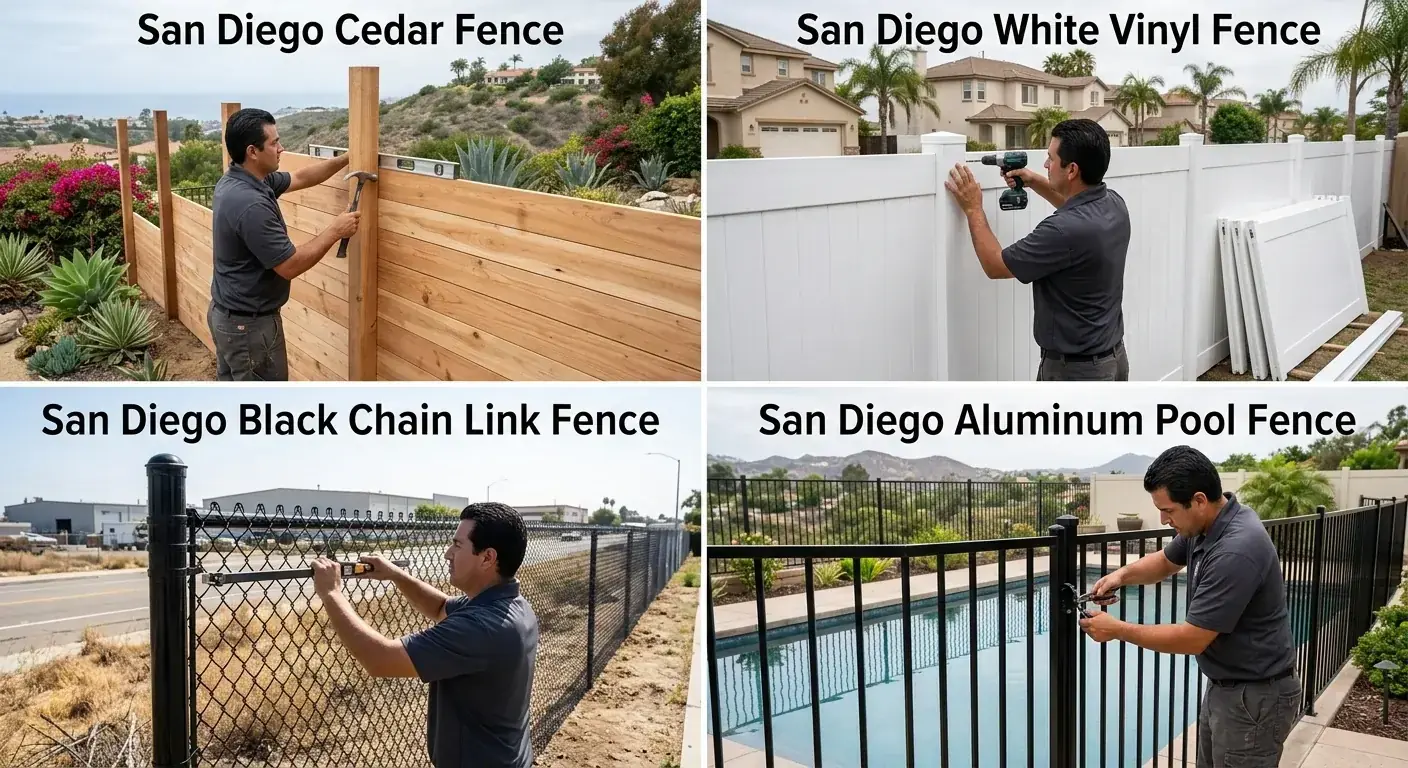
A collage of four different fence types in San Diego settings: a rustic cedar wood fence, a crisp white vinyl privacy fence, a functional black chain link fence, and an elegant aluminum pool fence.

Wood fencing: the classic choice for privacy

Wood fencing remains a perennial favorite for San Diego homeowners, and it’s easy to see why. Its natural warmth and versatility offer unmatched aesthetic appeal, making it a classic option for privacy and charm. Here in San Diego, popular choices include sturdy redwood and cedar, prized for their natural resistance to insects and rot, though regular maintenance is still key to their longevity against our intense sun and occasional moisture.

Pros of wood fencing:

  • Natural beauty: Wood offers a timeless, organic look that blends beautifully with landscaping and many architectural styles common in San Diego.
  • Excellent privacy: When installed as a solid panel or board-on-board design, wood creates a complete visual barrier, making it ideal for backyard seclusion.
  • Customization: You can paint, stain, or seal wood to match your home’s exterior, offering endless design possibilities. This allows for a truly personalized look, from rustic to modern horizontal styles.
  • Affordability: Generally, wood is a more budget-friendly option for initial installation compared to many other materials, especially when opting for pressure-treated pine over premium hardwoods.

Cons of wood fencing:

  • High maintenance: Wood requires ongoing care, including sealing or staining every few years to protect it from San Diego’s sun, moisture, and pests like termites. Without proper care, it can warp, crack, fade, or rot.
  • Shorter lifespan: Even with diligent maintenance, wood fences typically last 10-20 years, which is often shorter than vinyl or composite options.
  • Pest susceptibility: Despite natural resistance in cedar and redwood, wood is still vulnerable to termites, especially in our region, which can lead to costly repairs if not addressed promptly.

Typical use cases in San Diego: Wood fences are perfect for residential backyards where privacy is a top priority. They’re also great for defining property lines with a touch of classic charm, enclosing gardens, or enhancing curb appeal in traditional and Craftsman-style homes. If you love the look of natural materials and don’t mind the maintenance, wood is a fantastic choice. For more details on this timeless option, visit our wood fence installation page.

Vinyl fencing: the low-maintenance option

Vinyl fencing has soared in popularity across San Diego, becoming a go-to for homeowners seeking a beautiful fence without the upkeep. Made from PVC (polyvinyl chloride), vinyl offers a durable and attractive alternative to wood, specifically engineered to withstand environmental challenges like our coastal salt air and intense UV rays.

Pros of vinyl fencing:

  • Extremely low maintenance: This is vinyl’s biggest selling point. It never needs painting, staining, or sealing. A simple spray with a hose is usually enough to keep it looking clean. This frees up your weekends for enjoying San Diego, not working on your fence.
  • Exceptional durability: Vinyl won’t rot, warp, splinter, or be eaten by termites. It resists moisture, making it a great choice for properties near the coast or with irrigation systems.
  • Long lifespan: With proper installation, vinyl fences can last 20-30 years or even longer, offering excellent value over their lifetime.
  • Variety of styles: Available in a wide range of styles, from classic picket fences and full privacy panels to semi-private designs and decorative options, often mimicking the look of painted wood without the hassle.
  • Consistency: Vinyl maintains its color and appearance over time, resisting fading thanks to UV inhibitors in its composition.

Cons of vinyl fencing:

  • Higher initial cost: Vinyl typically has a higher upfront installation cost compared to wood. However, its low maintenance requirements often offset this over the long term.
  • Less natural appearance: While vinyl can mimic wood, it doesn’t offer the same organic texture and feel. Some homeowners prefer the natural aesthetic of real wood.
  • Repair challenges: If a panel or post gets severely damaged, individual sections might be harder to repair than wood and can sometimes require replacing larger components.
  • Expansion and contraction: Like all plastics, vinyl can expand and contract slightly with temperature changes, though quality installation accounts for this.

Typical use cases in San Diego: Vinyl fencing is perfect for homeowners who want privacy and a beautiful fence but have busy schedules or prefer minimal upkeep. It’s an excellent choice for pool enclosures (as it’s impervious to water), properties near the ocean where salt air is a concern, and families with children or pets due to its smooth, splinter-free surface. Learn more about the benefits and styles on our vinyl fence installation service page.

Chain link fencing is often overlooked for residential properties, but it’s a remarkably versatile, durable, and cost-effective option, particularly when security and budget are primary concerns. Made from woven steel wire, it provides a strong, transparent barrier that performs well in a variety of San Diego settings. Modern chain link fences have also evolved, offering more aesthetic options than the traditional galvanized silver.

Pros of chain link fencing:

  • Cost-effective: Chain link is generally the most budget-friendly fence material for initial installation, making it an excellent choice for large areas or when you need a functional barrier without a high investment.
  • High security: Its sturdy construction provides a secure perimeter, deterring trespassers and keeping pets safely contained. It’s tough to cut or climb without specialized tools.
  • Durability and longevity: Galvanized or vinyl-coated chain link is highly resistant to rust, corrosion, and the elements, offering a long lifespan with minimal maintenance.
  • Low maintenance: Like vinyl, chain link requires very little upkeep. You won’t need to paint, stain, or seal it.
  • Visibility: The open weave allows for clear visibility, which can be a pro for supervising children or pets, or for maintaining open views in certain areas.
  • Quick installation: Chain link fences are typically faster to install than other fence types, which can save on labor costs.

Cons of chain link fencing:

  • Limited privacy: The open design means chain link offers very little in the way of visual privacy. However, you can add privacy slats for a modest cost to mitigate this.
  • Aesthetics: While modern options like black or green vinyl-coated chain link improve its appearance, some homeowners still perceive traditional galvanized chain link as less attractive or more utilitarian than wood or vinyl.
  • Climbing hazard: For some pets or children, chain link can provide footholds, making it easier to climb than smooth surfaces.

Typical use cases in San Diego: Chain link fences are ideal for securing large yards, creating safe enclosures for pets, defining property boundaries without blocking views, and commercial properties needing a strong security perimeter. They’re also commonly used for temporary fencing solutions. If affordability, security, and low maintenance are your top priorities, chain link is a practical choice. Explore the versatility and affordability further on our chain link fence installation page.

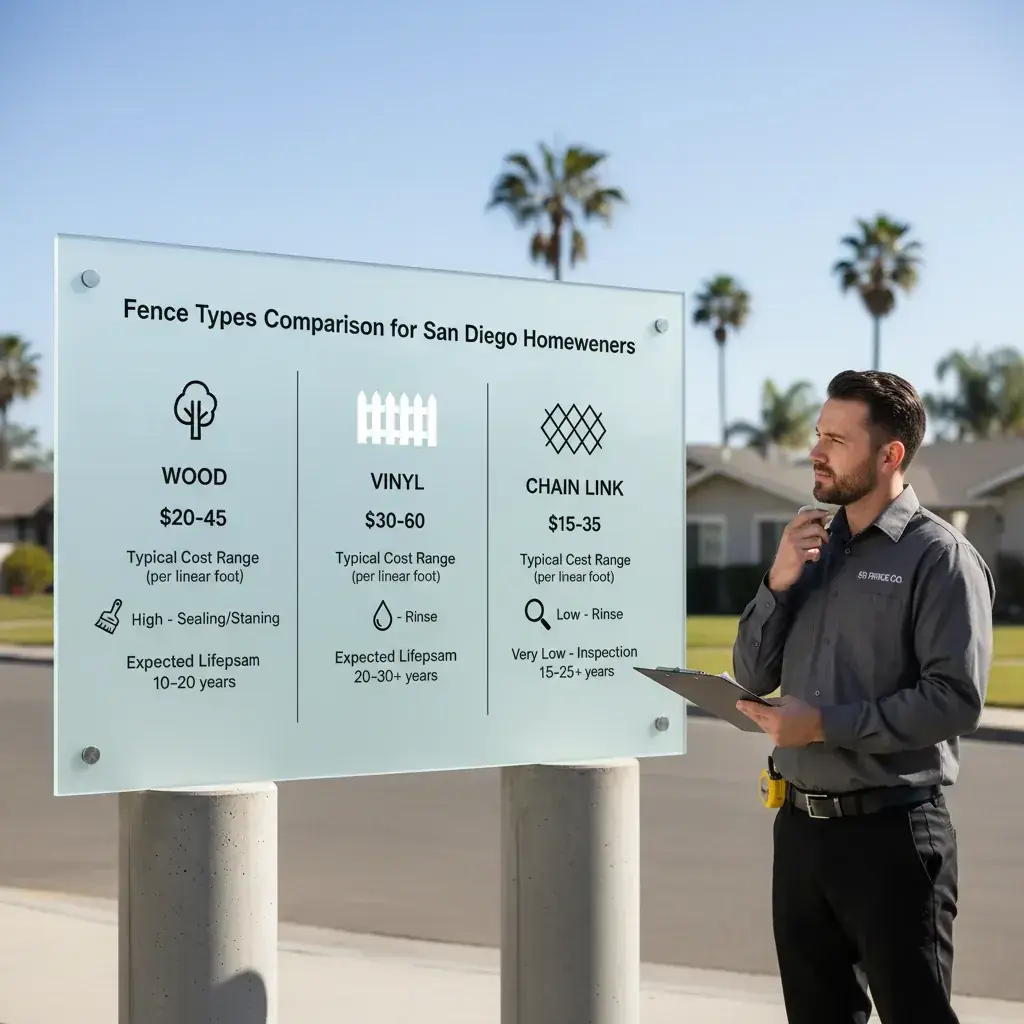
A comparative infographic illustrating the typical cost range, required maintenance, and expected lifespan for wood, vinyl, and chain link fencing in San Diego.

Aluminum and steel: for durability and style

When you’re looking for a fence that combines durability, elegant style, and strong security, metal options like aluminum and steel (often wrought iron or ornamental steel) are fantastic choices for San Diego properties. These materials offer a sophisticated look and incredible strength, often without compromising views.

Pros of aluminum and steel fencing:

  • Exceptional durability: Both aluminum and steel are incredibly strong and resilient. They stand up well to San Diego’s elements, including salt air (especially aluminum) and strong winds. They don’t rot, warp, or attract pests.
  • Low maintenance: Like vinyl, metal fences require minimal upkeep. Aluminum is particularly corrosion-resistant and often comes with a powder-coated finish that resists chipping and fading. Steel, when properly coated, also offers excellent longevity.
  • Elegant aesthetics: Ornamental aluminum and wrought iron fences offer a classic, sophisticated look that significantly enhances curb appeal. They can be designed with intricate patterns, finials, and custom gates.
  • Security: Their strength and inability to be easily cut or climbed make them excellent for security, especially for front yards or commercial applications.
  • Maintains views: The open design of many metal fences allows you to enjoy scenic views while still defining your property.
  • Pool code compliance: Aluminum and steel fences are popular choices for pool enclosures in San Diego, as they often meet local safety codes for height and spacing.

Cons of aluminum and steel fencing:

  • Higher initial cost: These are premium fencing materials, and their upfront cost is generally higher than wood or chain link.
  • No privacy: The open design, while great for views, offers no visual privacy. If seclusion is your main goal, you’d need to pair it with landscaping or another fence type.
  • Rust (steel): While powder-coated steel is highly resistant, any chips or scratches that expose the bare metal can lead to rust if not addressed. Aluminum is naturally rust-proof.
  • Weight (steel): Wrought iron can be very heavy, making installation more complex and impacting costs.

Typical use cases in San Diego: Metal fences are perfect for front yards where you want to enhance curb appeal and provide security without blocking views. They’re commonly used for decorative boundaries, pool fences that comply with local regulations, and for creating stately enclosures around estates or commercial properties. They’re also an excellent choice for gate installations due to their strength and potential for automation. You can learn more about specific applications for residential and commercial needs by checking out our dedicated blog post about aluminum fence in San Diego.

Composite: the premium modern alternative

Composite fencing represents a modern solution that marries the best qualities of wood and advanced synthetic materials. Typically made from a blend of wood fibers and recycled plastics, composite fences offer the aesthetic warmth of wood with the superior performance and low maintenance of vinyl. For San Diego homeowners seeking an eco-friendly and high-performance option, composite is an increasingly popular choice.

Pros of composite fencing:

  • Low maintenance: Like vinyl, composite fences never need staining, painting, or sealing. They resist rot, warp, and insect damage, requiring only occasional cleaning. This makes them ideal for busy San Diegans.
  • Durability and longevity: Designed to withstand harsh weather, composite fences are extremely durable and can last for decades (25-30 years or more) without significant degradation.
  • Aesthetic appeal: Composite mimics the look and feel of real wood, complete with authentic grain patterns and natural color variations, but without the drawbacks of actual wood. This allows for a premium, polished look.
  • Eco-friendly: Many composite products use recycled materials, making them a more sustainable choice for environmentally conscious homeowners.
  • Privacy: Most composite fences are designed as solid panels, providing excellent privacy for backyards and outdoor living spaces.
  • Splinter-free: The smooth, consistent surface is safe for children and pets.

Cons of composite fencing:

  • Highest initial cost: Composite fencing typically has the highest upfront installation cost among all the fence types discussed. This premium price reflects its advanced materials and longevity.
  • Color fading (minimal): While significantly more stable than wood, some lighter composite colors can experience very slight fading over many years, particularly in direct, intense San Diego sun, though it’s generally uniform.
  • Weight: Composite panels can be heavier than wood or vinyl, which can sometimes impact installation time and cost.
  • Heat retention: Darker composite colors can absorb and retain more heat than lighter materials.

Typical use cases in San Diego: Composite fencing is a top choice for upscale residential properties, modern architectural homes, and homeowners who want the natural look of wood combined with the ultimate in low maintenance and durability. It’s perfect for creating private outdoor living areas, enhancing contemporary landscape designs, and situations where long-term value and aesthetic consistency are paramount. You can dig deeper into this innovative material on our dedicated composite fence in San Diego blog post.

Frequently asked questions

What is the cheapest fence type for a San Diego property?

Chain link is the least expensive option, typically running $10 to $20 per linear foot installed, depending on height and gauge. For large yards or commercial lots where privacy is not a priority, it offers a solid security barrier at a fraction of the cost of wood or vinyl. If budget is the main driver but you still want some visual screening, you can add vinyl privacy slats to an existing chain link fence for a modest extra cost.

How much does fence installation cost per linear foot in San Diego?

Installed costs in San Diego generally range from $10 to $20 per foot for chain link, $20 to $35 for wood, $25 to $45 for vinyl, and $30 to $60 or more for aluminum, steel, or composite. Your total will depend on fence height, lot terrain, gate count, and material grade. You can get a same-day estimate by calling us at (858) 925-5546 or visiting our fence installation service page.

Which fence type holds up best against coastal salt air in San Diego?

Vinyl and aluminum are the top performers near the coast. Salt air accelerates corrosion and wood degradation, so untreated or under-maintained wood fences near the ocean can show rot and pest damage within five to seven years. Vinyl is entirely impervious to salt moisture, and powder-coated aluminum resists corrosion far better than bare steel or untreated wood. If you prefer a wood look in a coastal neighborhood, composite is a strong compromise since it won’t absorb moisture the way natural wood does.

How long does each fence type last in San Diego’s climate?

With proper installation, you can expect roughly 10 to 20 years from wood (longer with consistent sealing), 20 to 30 years from vinyl, 20 to 25 years from chain link (galvanized or vinyl-coated), 30 or more years from aluminum, and 25 to 30 years from composite. San Diego’s intense UV exposure is the primary aging factor for wood and lighter vinyl, so choosing UV-inhibitor-treated products and staining or sealing wood on schedule matters a lot for hitting the top end of those ranges.

Do I need a permit to install a fence in San Diego?

Most residential fences up to six feet tall on interior property lines don’t require a permit in San Diego, but front-yard fences, corner-lot fences, retaining-wall combinations, and pool fences are subject to specific height and setback rules. Permits are also required for fences over six feet. Rules vary by neighborhood and HOA, so it’s worth confirming with the City of San Diego Development Services Department or your HOA before installation begins.

What fence type requires the least maintenance in San Diego?

Vinyl and composite both require almost no ongoing maintenance: an occasional rinse with a garden hose is usually all it takes. Aluminum is a close second since the powder-coat finish resists chipping and fading for years. Wood is the highest-maintenance option, needing a fresh coat of sealant or stain every two to three years to prevent warping, cracking, and pest damage from termites, which are common in San Diego County.

When to call us

Deciding on the right fence type is a big decision, and it often helps to get expert advice tailored to your specific property and goals. Whether you’re considering a classic wood fence, a low-maintenance vinyl option, or a durable metal barrier, a licensed professional can help you navigate local codes, design choices, and ensure proper installation. For a personalized consultation and a same-day estimate, don’t hesitate to reach out. We’re here to help you choose and install the perfect fence for your San Diego home. Call us at (858) 925-5546 for a same-day estimate.