El Cajon is its own city, not a City of San Diego neighborhood. The useful hire question is which task you have: a rear privacy line that failed after inland heat and irrigation, a shared boundary, a rental turnover, a pool enclosure, or a stepped run toward Granite Hills, Bostonia, Fletcher Hills, or the Rancho San Diego edge. Photograph warped boards, loose fasteners, leaning posts, grade, and gate hardware before you compare wood, vinyl, metal, or chain link.
Fence Pros San Diego is a referral service. It does not install fences, set prices, or warrant work. An independent licensed professional confirms the site, scope, price, and any product terms with you.
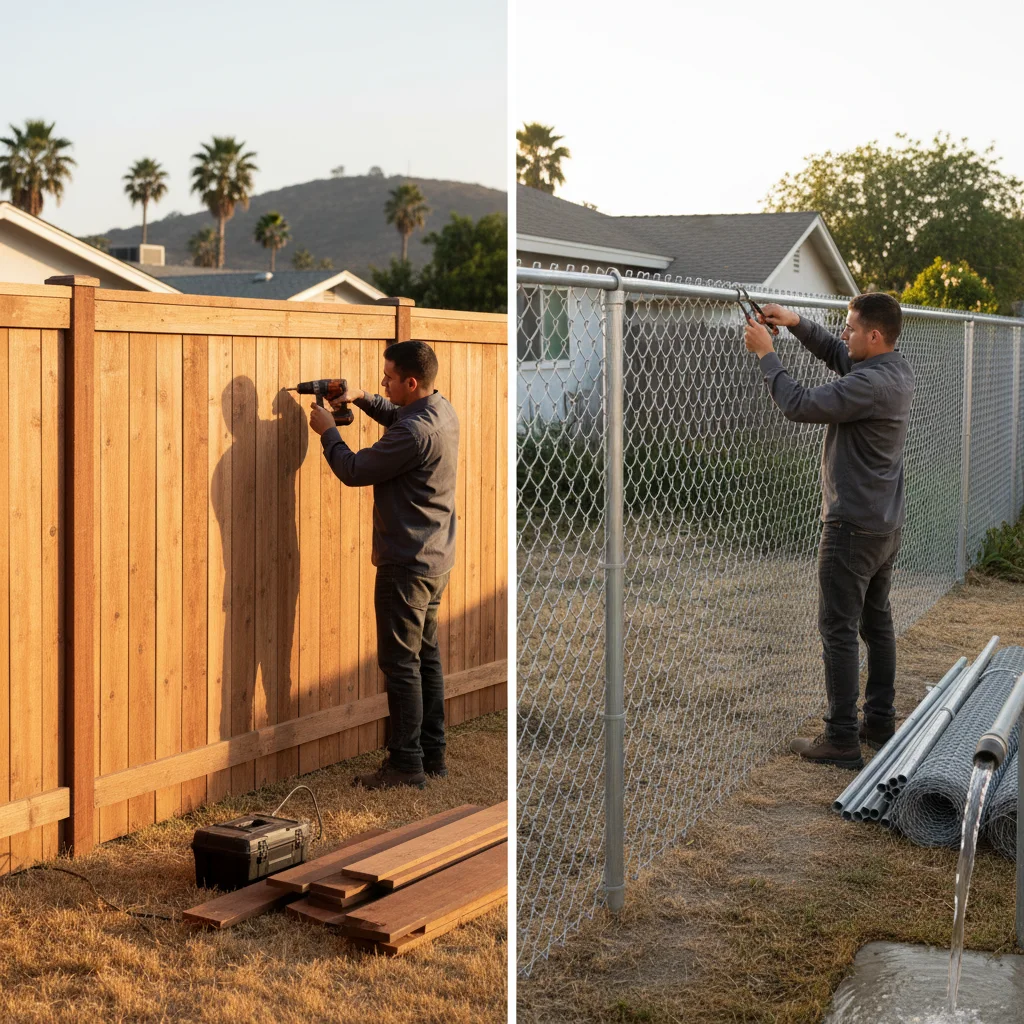
Match the material to the failure you can see
Do not pick a species from a citywide heat slogan. Inspect how this fence failed. Checking, cupping, and gray faces after full-sun summers are common inland, but irrigation at the posts, poor ground-contact detail, and undersized hardware fail fences too.
If you want wood, ask the proposal to name species, grade, finish, ground-contact posts, and fastener schedule. Compare that written spec with cedar, redwood, vinyl, or metal for the same line. A cheaper pine product is not automatically wrong. It is incomplete until you know how it will be finished and repaired. See cedar fence pros and cons for San Diego for the species questions, not a lifespan.
Vinyl is a maintenance conversation, not a climate trophy. Ask for the panel system, post reinforcement, gate framing, color, and how cut ends are protected. The vinyl fence guide for El Cajon stays on that product family.
Chain link still belongs on pet runs, side yards, long rear boundaries, and light-commercial perimeters where you need a line more than a screen. Privacy slats are a separate wind-load question. Start with chain link fence if that is the actual job.
Hillside and larger East County lots
Plenty of El Cajon property is not a flat tract backyard. Out toward Rancho San Diego, Granite Hills, Bostonia, and Fletcher Hills, the back edge often climbs or drops.
Ask each bidder how they will rack or step panels, and how they will treat drainage at grade changes. Require separate written footing notes for line, end, corner, and gate posts. Rocky or dense inland soil can change equipment and time. A bid that assumes a sandy coastal dig is not the same job.
Longer footage on a larger parcel also changes sequencing. Confirm the measured endpoints, gate openings, and whether old concrete comes out. None of that is a per-foot market rate. It is why two El Cajon quotes can look similar until you line up quantities.
City of El Cajon permits, not a copied San Diego table
Confirm height, corner visibility, reverse-corner setbacks, and the building-permit path with City of El Cajon Planning and Building for the exact address. Do not copy a neighboring fence. Do not use City of San Diego Table 142-03A as if El Cajon adopted it.
Some parcels near the city limits sit in unincorporated County instead. That is a different desk. County PDS 070 (building-permit exception for qualifying fences not over 6 feet that also meet zoning, plus 42-inch front or exterior-side and 72-inch rear or interior-side excerpts) applies only if the parcel is unincorporated. Confirm which office owns the address before you design.
Property lines are not the contractor’s legal finding. For a shared line, California Civil Code section 841 requires 30 days’ written notice to adjoining private landowners before incurring dividing-fence costs unless a written agreement says otherwise, and it presumes equal sharing of reasonable costs. Review the current text. HOA rules along the Rancho San Diego or Crestridge edge are a separate track.
Rental turnovers and pool enclosures
If the fence is on a rental, document who can authorize work, tenant notice, access windows, pets, and gate security. Ask the independent professional for a written schedule and site-security plan before you coordinate occupants. Fence Pros San Diego does not promise a turnover date.
If the fence is a pool enclosure, California Health and Safety Code sections 115922 and 115923 address qualifying safety features and enclosure details for covered new or remodeled private single-family pools. City of El Cajon still has to confirm the layout. See pool fence.
Choosing a fence company in El Cajon
Start with the license. California fence work generally needs a C-13 Fencing Contractor classification, which covers fences, gates, and related structures and excludes masonry walls. Check status at the CSLB license tool. Ask for general liability and workers’ compensation certificates that match the name on the proposal.
Business and Professions Code section 7048 exempts only aggregate contracts under $1,000 that are casual, minor, and do not need a building permit. A typical full fence job is outside that exemption.
Get a written scope that names material grade, height, post and footing notes, gate count, removal, disposal, and who pulls any city paper. Ask who will be on site: the contractor’s employees or another crew. Fence Pros San Diego does not employ installers and does not warrant their workmanship.
Frequently asked questions
What’s the best fence material for El Cajon’s heat?
There is no citywide winner. Compare the exact product against the failure you photographed: sun, irrigation, ground contact, fasteners, and repair parts. Cedar, redwood, Class-named vinyl, and chain link answer different tasks.
Do I need a permit to install a fence in El Cajon?
Ask City of El Cajon for this address, height, yard location, and whether a pool is enclosed. Unincorporated pockets use County PDS, not the city counter. A neighboring six-foot fence is not the rule.
How much does a new fence cost in El Cajon?
Fence Pros San Diego does not publish per-foot rates. Compare itemized proposals for the same measured line: demolition, footings, named product, gates, hardware, access, disposal, and city review. Hillside stepping belongs in that list, not as an invented adder.
Why is chain link so common in El Cajon?
It marks a boundary, contains pets, and stays see-through on larger or older lots where privacy is not the job. Slats are optional. They change wind load. Confirm both with the written spec.
When to call us
If you are planning a fence in El Cajon, call (858) 400-4906. We can connect you with an independent licensed fence professional. You contract and pay that professional directly. Browse fence service in El Cajon or fence installation first.